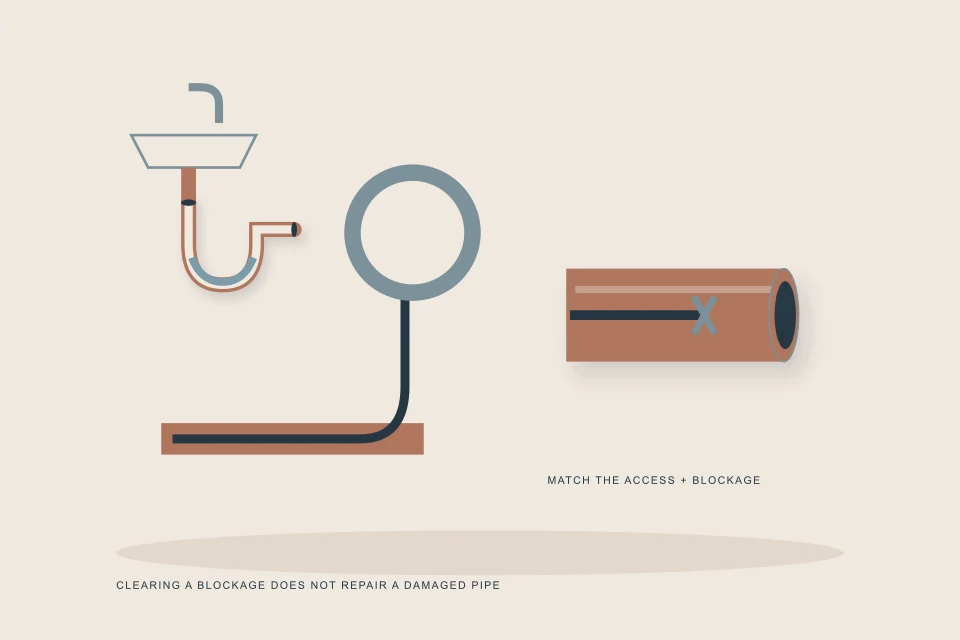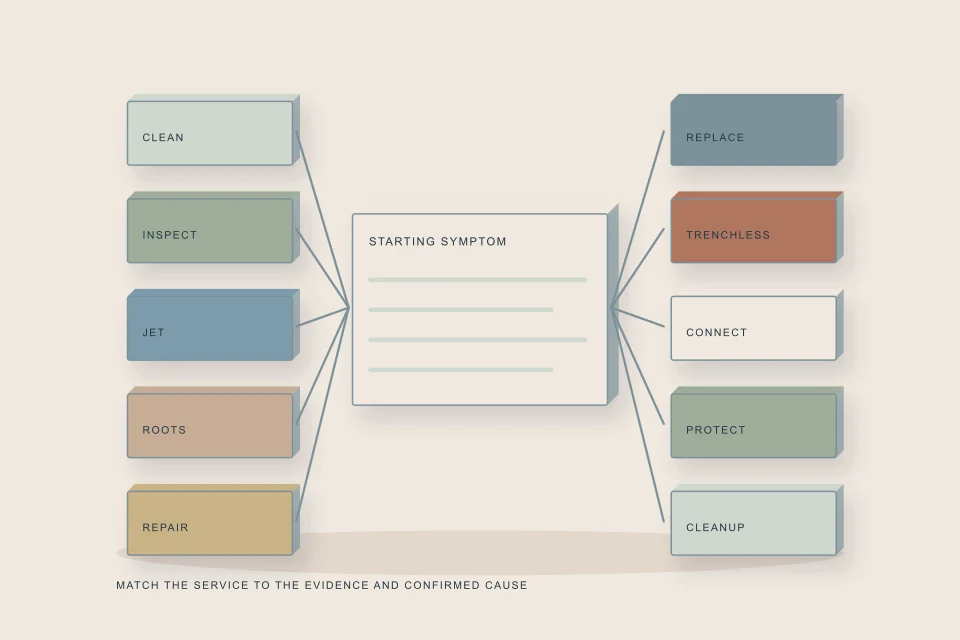
Match the service to the question you need answered. If water is backing up, you need drain cleaning now. If you need to know why, you need a camera inspection. If the camera found damage, you need repair, trenchless lining or replacement depending on how much and what kind. Sewage in the house needs cleanup, and storm-driven backups call for a backwater valve.
- Every sewer job falls into one of ten lanes, and most real problems move through two or three of them in a predictable order.
- Cleaning restores flow, the camera explains the cause, and repair, lining or replacement removes it.
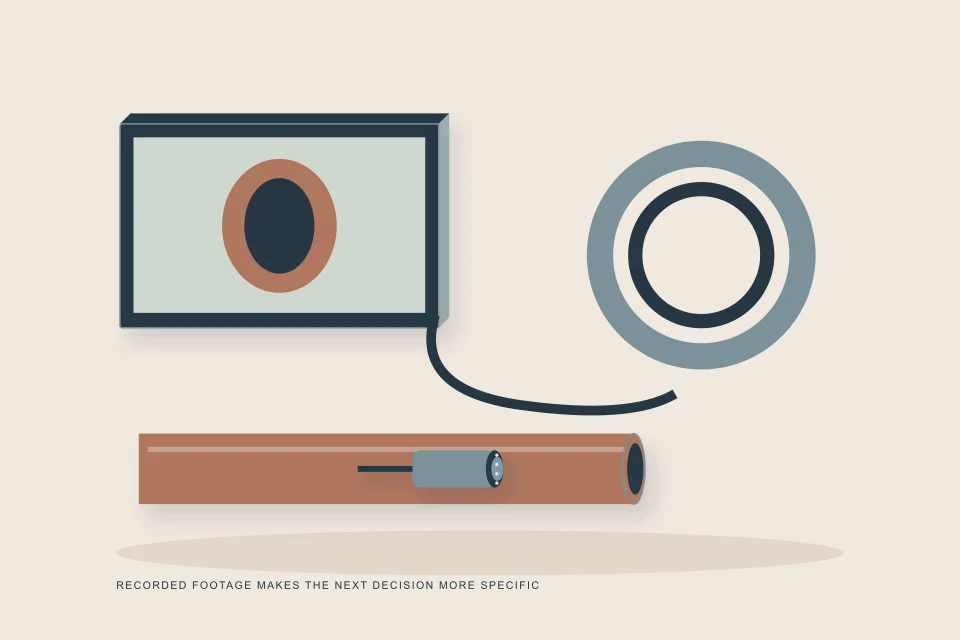
- The camera is the hinge: nearly every decision about money should wait for footage.
- Condos, townhouses and commercial buildings add a step before any lane: finding out who is responsible for the pipe.
- Urgency changes the order only once: when sewage is coming in, clearing the line comes before everything else.
01 /What are the ten sewer service lanes?
Sewers.ca organises sewer work into ten service lanes, each with its own page. They differ in what question they answer, what equipment they use and what they leave unsolved. Reading down this table is the quickest way to see where your problem sits.
| Lane | Question it answers | Typical trigger | Leaves unsolved |
|---|---|---|---|
| Camera inspection | What is wrong, and where? | Recurring clogs, smells, buying a house | Nothing is fixed yet |
| Drain cleaning | How do I get water moving? | One or more drains blocked | Why it blocked |
| Hydro jetting | How do I clean the whole pipe wall? | Grease, scale, fine roots on camera | Joint and shape defects |
| Root removal | How do I clear roots now? | Roots on the cable or camera | The joints roots use |
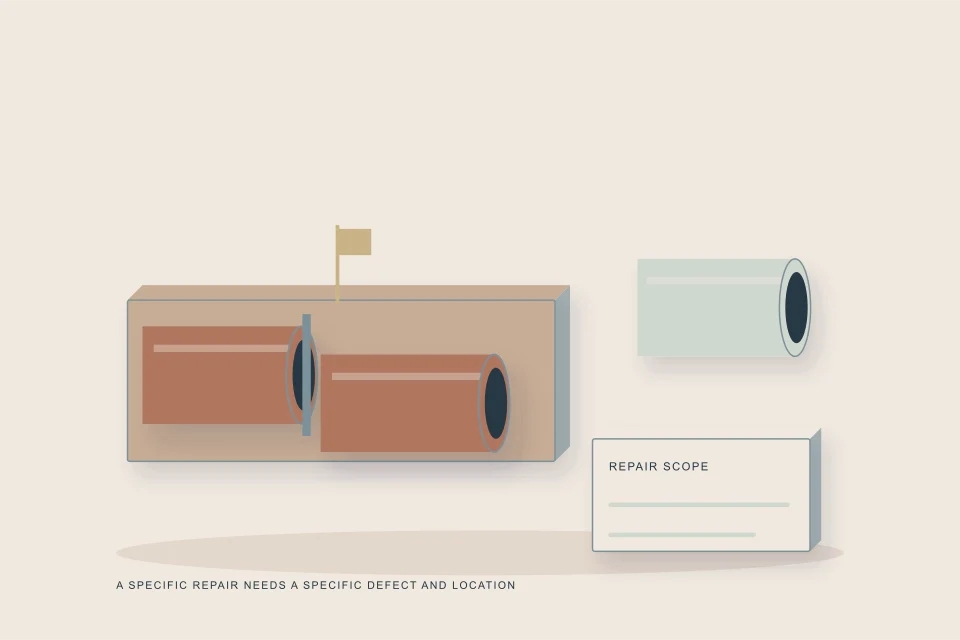
| Sewer repair | How do I fix one located defect? | One or two defects in sound pipe | The rest of an old line |
| Sewer replacement | How do I renew the whole line? | Collapse, sag, widespread damage | Little, if done well |
| Trenchless repair | Can I renew it with less digging? | Round pipe damaged along its length | Sags and collapses |
| New sewer connection | How do I connect a new building? | New build, infill, rebuild | Not applicable |
| Sewage cleanup | How do I make the space safe? | Sewage entered the building | The pipe problem |
| Backwater valve | How do I stop the main backing up into my house? | Storm-driven backups | Clogs in your own line |
02 /In what order do sewer services usually happen?
Most sewer problems follow one of a handful of sequences. Knowing the sequence stops you paying for step three before step two has been done.
| Situation | Usual sequence |
|---|---|
| Floor drain backing up in dry weather | Cleaning, then cleanup if needed, then camera, then repair lane |
| Floor drain backing up during a storm | Cleaning or waiting for the main to drain, cleanup, then backwater valve |
| Clogs every few months | Camera, then jetting or root removal, then repair or lining |
| Buying an older house | Camera before your condition deadline, then quotes if damage is found |
| Camera found widespread damage | Quotes for lining, bursting and open cut from the same footage |
| Tearing down and rebuilding | Camera the old service, then new connection or reuse approval |
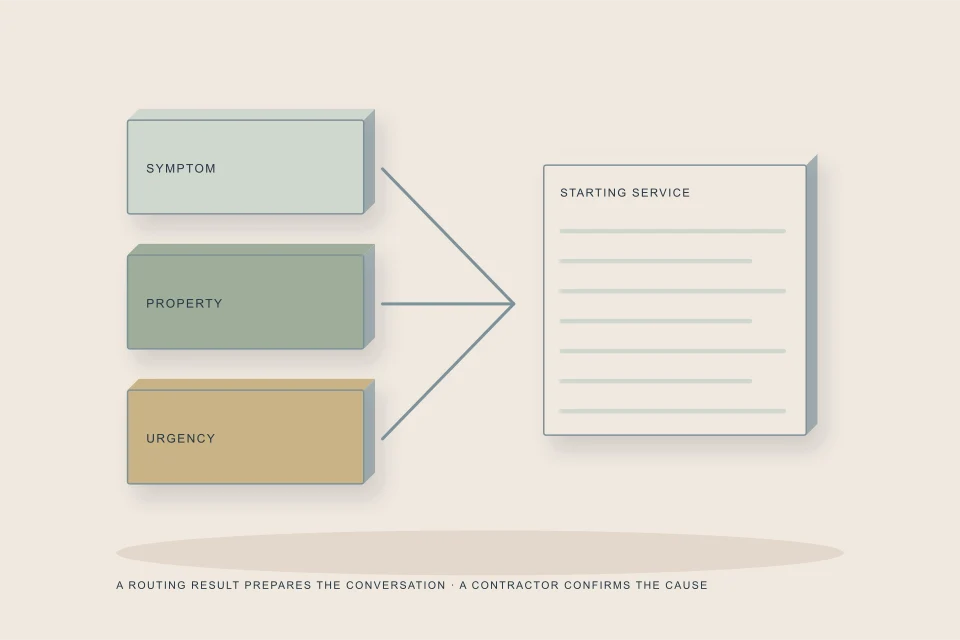
The Sewer Service Selector turns this into a three-question tool: pick the symptom, the property type and the urgency, and it returns the first lane and any follow-on lanes with links to each page.
03 /How do you choose between cleaning, repair and replacement?
The footage decides. Cleaning is right when the pipe is sound and something is in it. Repair is right when the pipe is sound except in one or two places. Lining is right when the pipe is damaged along its length but still round, continuous and on grade. Replacement is right when the pipe has lost its shape, its slope or its continuity.
Two rules of thumb help when quotes disagree. First, a contractor who recommends replacement should be able to point to the frames of video that rule out repair or lining. Second, several spot repairs on the same old line should always be priced against a full-length option.
04 /Does the type of property change which service you need?
The lanes are the same; who decides, who pays and how the work is scheduled change. The selector adds a note for each property type because these steps come before any contractor is called.
- Detached house. The owner is usually responsible for the private portion, often to the property line. Confirm the boundary with your municipality.
- Condo or townhouse. Shared lines are often the condominium corporation's responsibility. Check with the board or property manager before booking anything, and read the declaration and bylaws.
- Commercial or multi-unit. Access, business hours, tenant notices and grease rules shape the work, and larger pipes use different equipment. See the commercial and multi-unit page.
05 /When should the order change because of urgency?
Only when sewage is actively coming in, or when several fixtures have stopped draining. Then the first job is to stop the flow: stop using water, keep people away, and get the line cleared. The selector shows a "Right now" warning for a floor-drain backup, several slow drains or an after-backup situation when you mark it as happening now.
Everything else can be planned. A smell, a slow drain, a pre-purchase inspection or damage found on camera all leave time to gather footage, confirm responsibility and compare two or three quotes.
06 /What does each lane typically cost?
As 2026 planning figures: cleaning about $200 to $450, jetting $400 to $900, a camera with locate $250 to $600, a backwater valve $1,800 to $4,500, a spot repair $3,500 to $9,000, and full-length lining, bursting or open-cut replacement of a 15 m lateral roughly $9,000 to $24,500 before difficult surfaces.
If you still are not sure which lane you are in, describe the symptoms to the HAUSE Sewer desk and include the house's age, any footage and any quotes you already have.
FAQQuestions people ask
What is the difference between a plumber and a sewer contractor?
Plumbers work on the whole drainage and water system and many also clean and repair sewer lines. Some companies specialise in sewer work such as camera inspection, jetting, lining or excavation. What matters is whether the company has the equipment and experience for the specific lane you need.
Should I get a camera inspection before any sewer repair?
Yes, for anything beyond clearing a blockage. Repair, lining and replacement should be priced from recorded footage that shows the defect, its distance from the access point and, ideally, its depth.
Can one contractor handle every sewer service?
Some can, but many specialise. It is common for one company to clear and film the line and another to line or replace it. Sharing the same footage with each keeps the quotes comparable.
How do I know if my problem is the city's sewer or mine?
Backups during heavy rain that affect neighbours point to the municipal system; dry-weather backups in one house usually point to that house's line. Your municipality can investigate its side, often through 311.
Is a slow drain always a sewer problem?
No. One slow fixture is usually a clog in that fixture's trap or branch. Several slow fixtures at once, gurgling at the floor drain, or water appearing in the basement when upstairs fixtures run point to the main line.
Which sewer service adds the most protection for the money?
It depends on the risk. For storm-driven backups, a maintained backwater valve is often the strongest single step. For a line with a known defect, fixing that defect is. A camera inspection tells you which risk you actually have.
NETWORKGo deeper across the HAUSE Sewer network
Inspecting the sewer after a backup: finding out why it happened
Why a sewer camera inspection after a backup matters: private vs municipal causes, timing, what to record for insurance, and how to stop it happening again.
SewerCleaners.caMain sewer line cleaning: what is actually involved
Main sewer line cleaning explained: how pros access the line, cable vs jetting, camera proof, how long it lasts, and what a complete job should include.
SewerQuotes.comEmergency and after-hours sewer service pricing
Emergency sewer service pricing in Canada (2026): after-hours call-out fees and surcharges in CAD, what to authorise at 2 a.m., and what can wait.