Short answer
This glossary defines the words contractors, inspectors and city staff use about sewers, from the parts of a home drainage system to defect names, repair methods and municipal terms. Each definition is written to stand on its own, and links from the service pages lead here when a term needs unpacking.
Key takeaways
- Knowing a handful of terms, such as lateral, cleanout, belly and offset, makes quotes and camera reports much easier to follow.
- Many terms have several names: lateral, building sewer and service line often mean the same pipe.
- Defect codes on formal reports follow systems such as NASSCO PACP; plain-language names are listed here.
01 /How to use this sewer glossary
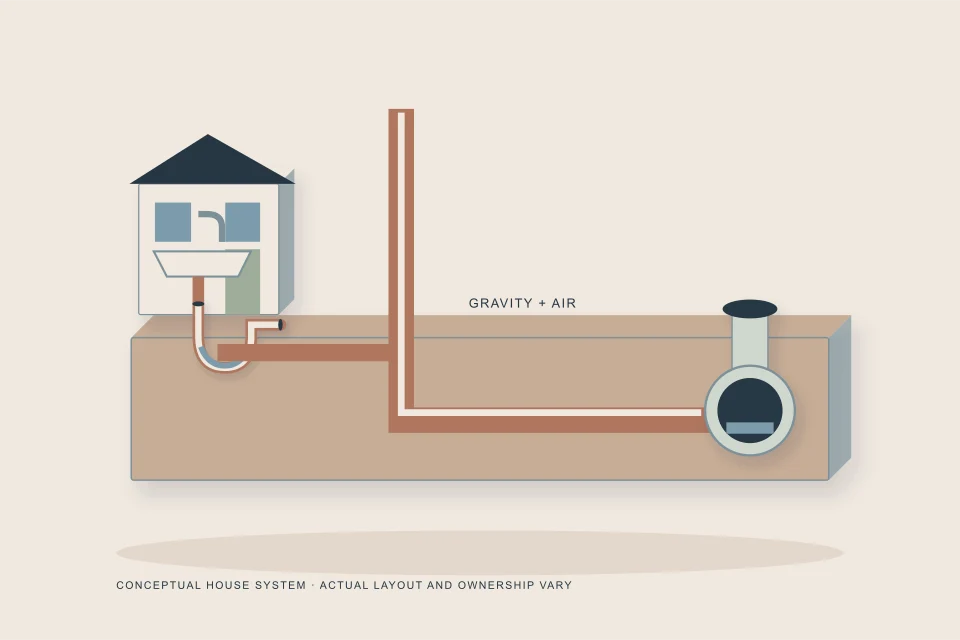
Terms are listed alphabetically. Where a term has a service page, it is the best place to go next: camera inspection, trenchless repair, backwater valves and the rest. For how the parts fit together, read how a home sewer system works.
A–ZTerms
- ABS
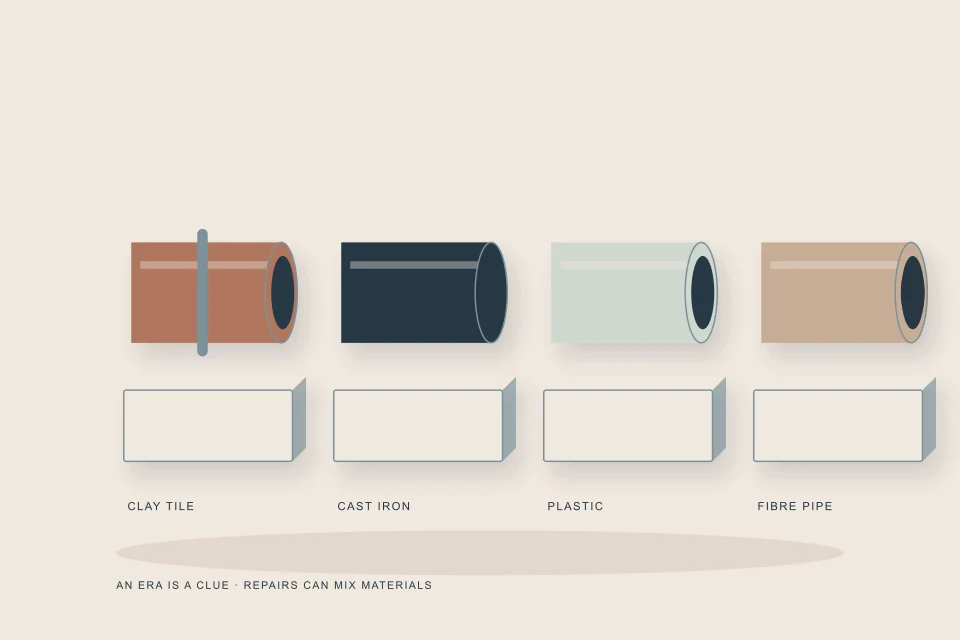
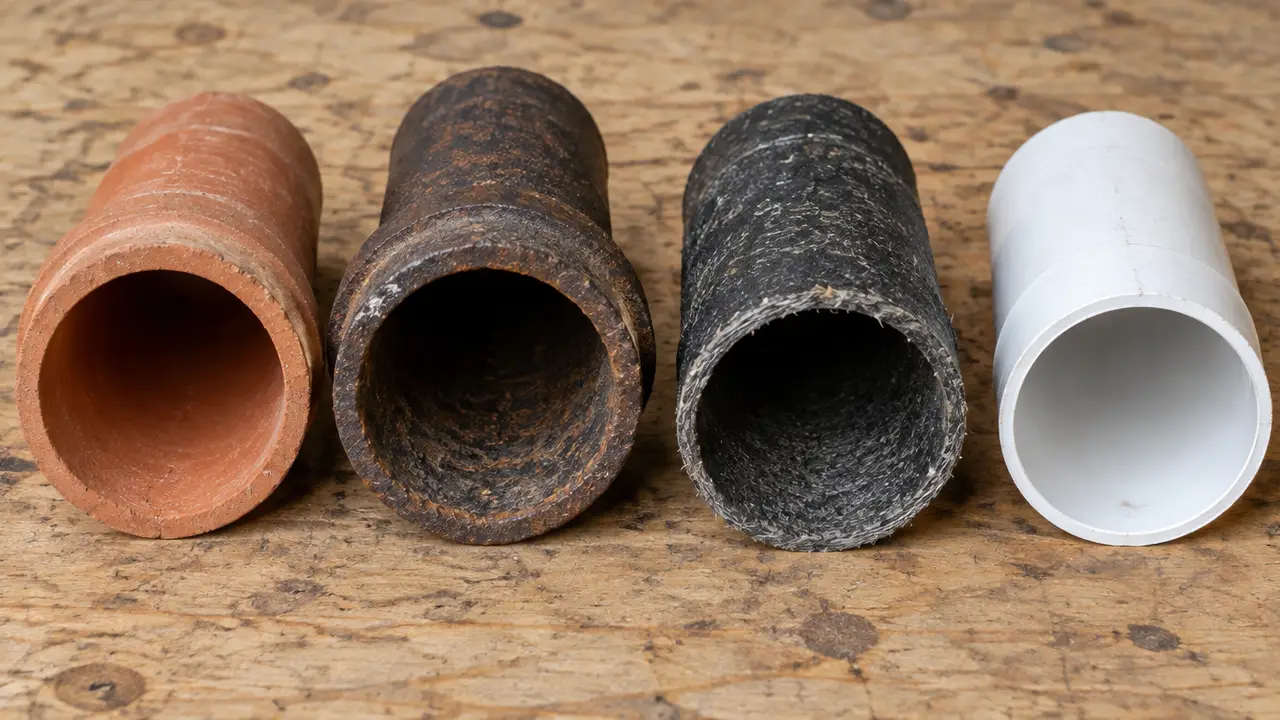
- Acrylonitrile butadiene styrene, a black plastic pipe widely used for drain, waste and vent piping inside Canadian homes since roughly the 1970s.
- Access pit
- A small excavation that gives equipment entry to a buried pipe, used in trenchless lining and bursting instead of a full-length trench.
- Asbestos-cement pipe
- Pipe made of cement reinforced with asbestos fibres, used for some mid-century services and mains. Generally stable if undisturbed; cutting or breaking it is specialist work.
- Auger
- A rotating steel cable with a cutting or retrieving head, fed into a drain to open or pull out a blockage. Also called a snake or drain cable.
- Backfill
- Soil or granular material placed back into a trench around and over a pipe, compacted in layers to prevent later settlement.
- Backwater valve
- A one-way valve on the main sanitary drain that closes when sewage flows back from the municipal main, protecting below-grade fixtures.
- Bedding
- The compacted granular layer a pipe rests on. Poor bedding is a common cause of sags and offset joints.
- Belly
- A low spot in a sewer line where the pipe has sagged, so water and solids collect instead of flowing. Also called a sag.
- Bituminous fibre pipe
- Pipe made of wood fibre and pitch, often called Orangeburg, used in some mid-century homes. It deforms with age and usually needs replacement.
- Building drain
- The lowest horizontal drain inside a building, usually under the basement floor, collecting from the stacks and carrying waste to the building sewer.
- Building sewer
- The pipe from just outside the foundation to the municipal main or private system. In everyday use, the same as the lateral.
- Bursting head
- The cone-shaped tool pulled or pushed through an old pipe in pipe bursting, fracturing it outward while drawing new pipe behind.
- Bypass pumping
- Temporarily pumping wastewater around a pipe section so it can be repaired or replaced while the system stays in service.
- Camera inspection
- Recording the inside of a drain or sewer with a waterproof camera on a push rod or crawler, with a distance counter and often a locator.
- Cast iron pipe
- Heavy metal pipe common in older building drains and stacks. It corrodes from the inside, building scale and eventually thinning or cracking.
- CCTV inspection
- Closed-circuit television inspection; the industry name for a sewer camera inspection, especially with crawler cameras on larger pipe.
- CIPP
- Cured-in-place pipe: a resin-saturated liner inserted into an existing pipe and hardened with hot water, steam or ultraviolet light to form a new pipe inside it.
- Cleanout
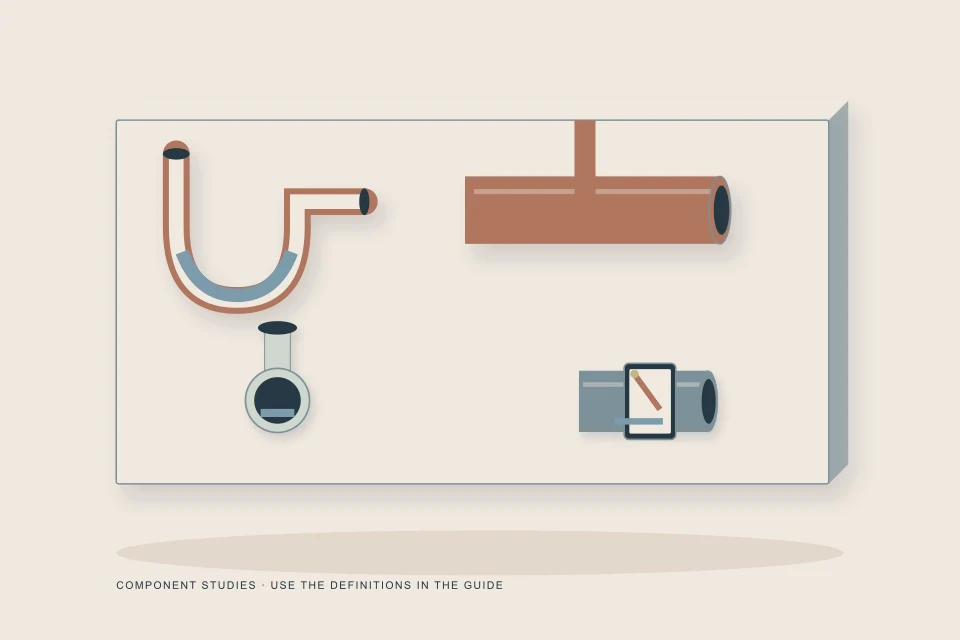
- A capped fitting that gives access to a drain or sewer for cleaning and cameras without removing fixtures.
- Combined sewer
- A municipal sewer that carries both sanitary wastewater and stormwater in one pipe, found in older parts of some cities and prone to overload in heavy rain.
- Confined space
- An enclosed space with limited entry and exit, not designed for continuous occupancy, such as a manhole or sewer. Entry requires testing and trained crews.
- Coupling
- A fitting that joins two pipe ends, including transitions between different materials. Shielded couplings resist shifting better than plain rubber sleeves.
- Descaling
- Removing hard mineral or corrosion buildup from inside pipe, often cast iron, with chain knockers, abrasive heads or jetting.
- DWV
- Drain-waste-vent: the gravity drainage and venting system in a building, as opposed to the pressurised water supply.
- Easement
- A legal right for someone other than the owner to use part of a property, sometimes covering a shared or utility sewer line.
- Ejector pump
- A pump that lifts sewage from fixtures below the level of the building drain or municipal main up to where it can flow by gravity.
- FOG
- Fats, oils and grease: kitchen waste that cools and hardens on pipe walls. Cities regulate it for food businesses through grease interceptor rules.
- Fracture
- A crack in a pipe that has visibly opened, with pieces separated. More serious than a hairline crack.
- Frost depth
- How deep the ground freezes in winter. It varies by region and by surface; cleared driveways let frost go deeper than snow-covered lawn.
- Grease interceptor
- A tank that slows kitchen wastewater so grease floats and solids settle before the flow reaches the sewer. Required for food businesses in many cities.
- HDPE
- High-density polyethylene pipe, joined by heat fusion into a continuous length; commonly pulled into place in pipe bursting.
- Hydro jetting
- Cleaning a sewer with high-pressure water through a nozzle whose rear jets pull the hose forward and scour the pipe wall.
- Hydrogen sulphide
- A toxic, flammable gas with a rotten-egg smell found in sewers. It can dull the sense of smell, so odour is not a reliable warning.
- Hydrovac
- Excavation that loosens soil with pressurised water and removes the slurry by vacuum, used to expose buried utilities with less strike risk.
- Infiltration
- Groundwater entering a sewer through cracks, open joints or defects. It adds to flow and can carry soil into the pipe.
- Inflow
- Stormwater entering a sanitary sewer through direct connections such as downspouts, sump discharges or leaking manhole covers.
- Invert
- The inside bottom of a pipe. Invert elevations tell designers whether a new service can drain to the main by gravity.
- Joint
- Where two lengths of pipe meet. Older clay pipe has a joint roughly every metre, which is where roots and offsets usually occur.
- LACP
- NASSCO's Lateral Assessment Certification Program, a standard coding system for describing defects in service laterals.
- Lateral
- The pipe connecting a building to the municipal sewer main. Also called the service line or building sewer.
- Locate
- Marking the position of buried utilities on the ground before digging. Public locates do not include customer-owned lines such as a private sewer lateral.
- Main
- The municipal sewer pipe, usually under the street or lane, that collects flow from many laterals.
- Manhole
- An access structure into the municipal sewer system, and a confined space that only trained, equipped crews should enter.
- NASSCO
- A North American association that sets training and coding standards for assessing and rehabilitating underground pipes, including PACP, LACP and MACP.
- Offset joint
- A joint where two pipe sections have shifted out of line, leaving a lip that catches debris and can let soil in.
- Open cut
- Replacing or repairing a sewer by excavating a trench along it, the traditional method that can correct slope and route.
- Orangeburg pipe
- A common name for bituminous fibre pipe, used in some mid-century homes and prone to deforming and collapsing.
- PACP
- NASSCO's Pipeline Assessment Certification Program, the standard coding system for defects in sewer mains, widely used by municipalities.
- Pipe bursting
- A trenchless replacement method that breaks the old pipe outward with a bursting head while pulling a new pipe into its place.
- Point repair
- A repair confined to one location, by a short sectional liner or a small excavation. Also called a spot repair.
- Property line
- The legal boundary of a lot. In many Canadian cities it is where the owner's sewer responsibility ends and the municipality's begins.
- PVC
- Polyvinyl chloride pipe, the most common material for modern residential sewer laterals in Canada, joined with gaskets or solvent cement.
- Reinstatement
- Reopening a branch connection from inside a pipe after lining, usually with a remote-controlled cutter.
- Root intrusion
- Tree or shrub roots growing into a pipe through joints or cracks, forming masses that catch debris and block flow.
- Sag
- Another word for a belly: a section of pipe that has sunk below its intended slope and holds water.
- Sanitary sewer
- The sewer system that carries household and business wastewater to treatment, separate from storm sewers in most newer areas.
- Sectional liner
- A short cured-in-place liner installed at a single defect, such as a cracked joint, without lining the whole pipe.
- Sewer gas
- The mix of gases in sewers, which can include hydrogen sulphide and methane. Water-filled traps keep it out of the house.
- Slope
- The downward fall of a drain in the direction of flow. The plumbing code sets minimums; too little slope lets solids settle.
- Sonde
- A small radio transmitter in a camera head or on a cable, detected from the surface to find a pipe's position and approximate depth.
- Stack
- A vertical drain pipe that collects waste from fixtures on each floor and extends upward through the roof as a vent.
- Storm sewer
- The system that carries rain and snowmelt from streets, roofs and lots, usually to a waterway without treatment.
- Sump pump
- A pump in a basement pit that removes groundwater collected by foundation drainage and discharges it away from the house.
- Surcharge
- When a sewer main carries more flow than its capacity and the water level rises above the pipe, which can push sewage back up laterals.
- Trap
- A U-shaped bend in a drain that holds a water seal to stop sewer gas entering the building. Unused traps can dry out.
- Trenchless
- Methods that repair or replace buried pipe with little or no trench, such as cured-in-place lining and pipe bursting.
- Vent
- Piping open to the outside air, usually through the roof, that lets air into the drainage system so water flows and traps are not siphoned.
- Vitrified clay pipe
- Fired clay pipe used for many older sewer laterals. Chemically durable but brittle, with frequent joints that roots and ground movement exploit.
- Weeping tile
- Perforated foundation drainage pipe around a basement footing that collects groundwater, usually draining to a sump or storm system.