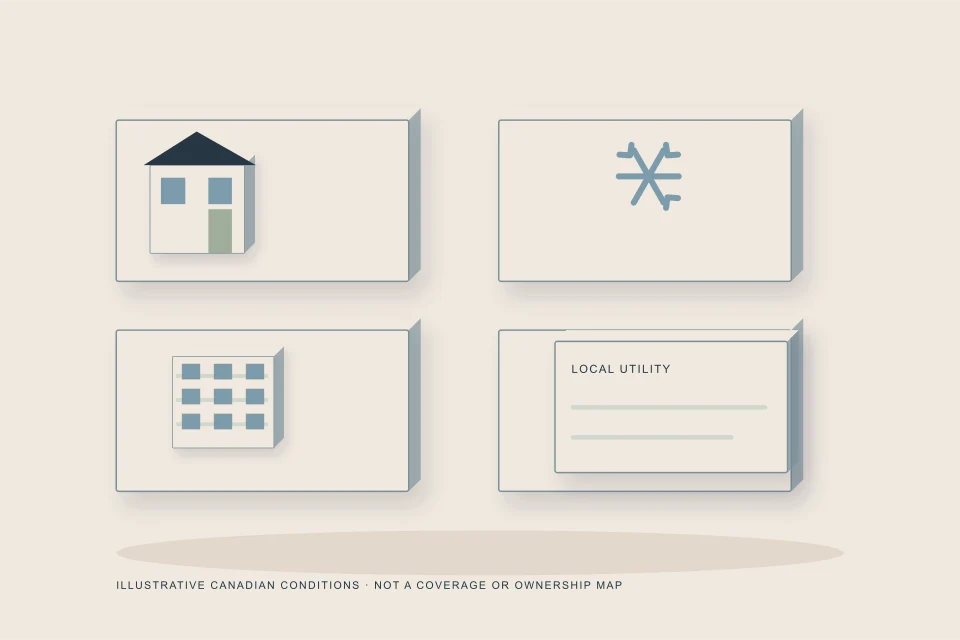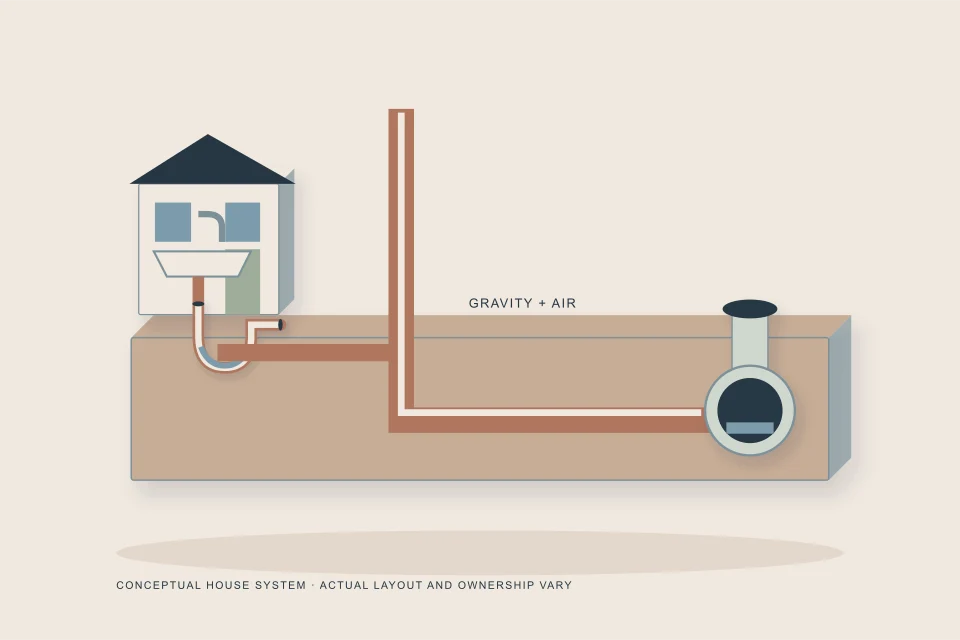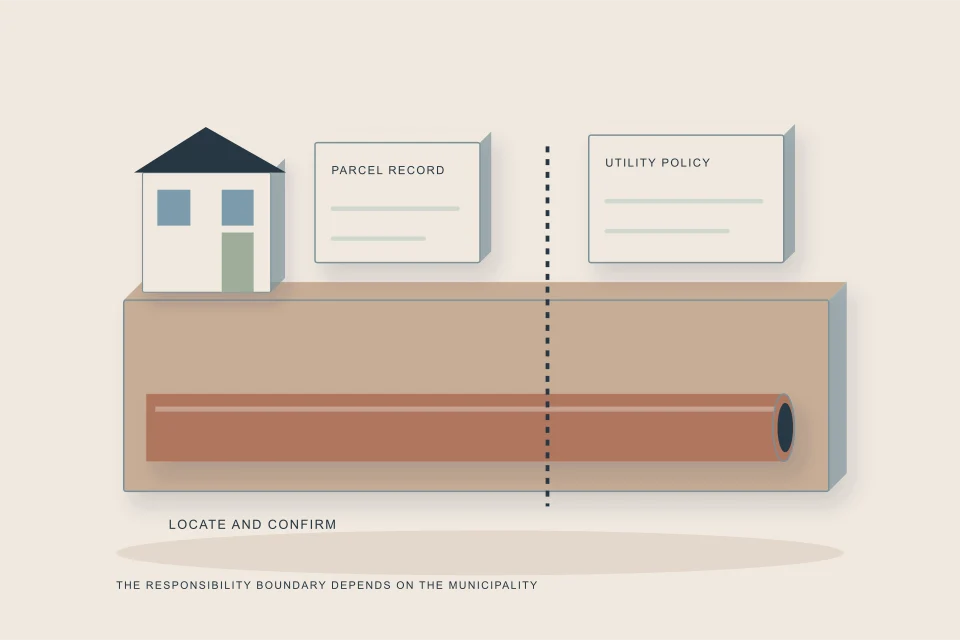
In most Canadian cities, the property owner owns and maintains the sewer service line from the building to the property line, and the municipality owns the pipe from the property line to the main. There are exceptions: Winnipeg makes owners responsible for the whole service line, including under the street. Condominiums and shared laterals add another layer, so confirm your boundary before paying for work.
- The property line is the usual boundary, but it is a legal line, not a fitting you can see in the pipe.
- Your municipality's answer, not a contractor's assumption, decides who pays for work near the boundary.
- Condominium corporations often own shared drains; townhouses and semi-detached homes can share a lateral.
- Several cities investigate backups on request and some reimburse owners when the blockage proves to be on the public side.
- Keep camera footage with distances: it is the evidence that shows which side of the line a defect sits on.
01 /Where does the homeowner's sewer responsibility usually end?
At the property line, in most of the Canadian cities checked for this guide. Calgary's open data describes the sanitary service pipe as two sections: main to property line, owned and maintained by the City, and property line to house, owned and maintained by the homeowner. Toronto, Edmonton's utility EPCOR, and Halifax Water describe the same split in their own words.
The property line itself is usually not where the sidewalk or curb is. Many lots end some distance behind the sidewalk, with a strip of municipal boulevard between. A contractor measuring from your foundation needs the lot dimensions from your real property report or title plan to know which metres of pipe are yours.
02 /Which Canadian cities do it differently?
Winnipeg is the clearest exception found. The city states that property owners own the sewer pipe that serves their property from the house to where it connects with the City's main, including the portion under the street. It runs a financial assistance program for some owner-occupied single-family and two-family homes when the under-street portion fails, with exclusions.
| Model | Example | What it means for you |
|---|---|---|
| Split at the property line | Calgary, Edmonton (EPCOR), Toronto, Halifax Water | Defects beyond the property line are the utility's to fix |
| Owner owns the whole service | Winnipeg | The owner is responsible even under the street, subject to any assistance program |
| Split, with conditions on cause | Edmonton (EPCOR) blockages from prohibited waste | The utility may clear its side but charge if what you flushed caused it |
Other municipalities, smaller towns and rural utilities set their own rules, and some change them over time. The across Canada page summarises backup procedures and subsidies for the same cities.
03 /How do you confirm who owns the section with the problem?
- Get footage with distances
A camera inspection records each defect's distance from the access point. Ask for a surface locate so the spot can be marked in the yard.
- Find your property line
Use your real property report, survey or title plan. Measure from the foundation along the lateral's route.
- Call the municipality first
Report the backup or defect through 311 or the utility's line. Many will check their own side; Calgary's 311 agents triage whether you need a plumber or a City inspection.
- Share the evidence
Send the video and the locate to the municipality if the defect is at or near the boundary.
- Get the answer in writing
Before paying for work near the line, keep the utility's response on file.
04 /How do condos, townhouses and shared laterals change responsibility?
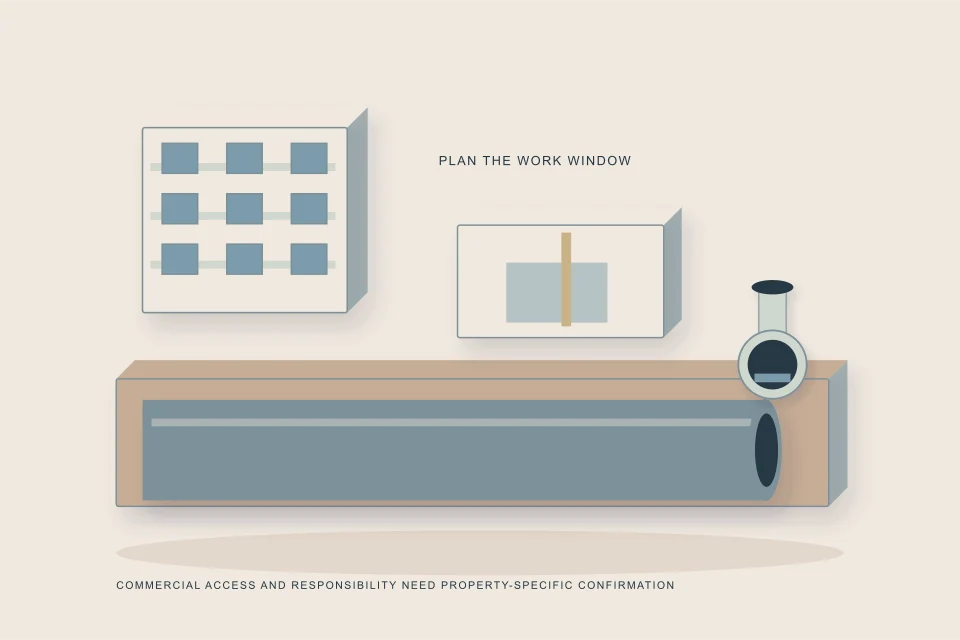
In a condominium, the building's drains and the service connection are usually common property, maintained by the corporation. The unit owner is typically responsible for fixtures and drains within the unit, but the exact line is set by the declaration, bylaws and provincial condominium law. Always ask the board or property manager before booking a contractor for a shared line.
- Apartment-style condos. Stacks, building drains and the lateral are usually common elements.
- Townhouse condos. Each unit may have its own lateral, or several may share one; the plans and declaration decide.
- Freehold semis and row houses. Older properties sometimes share a single lateral under both lots, which can require a neighbour's cooperation and sometimes an easement.
- Rentals. Landlords are normally responsible for the building's sewer; tenants should report symptoms promptly in writing.
The Sewers.ca service selector adds a condo note to every result for this reason, and the commercial and multi-unit page covers larger buildings.
05 /Who pays when a city tree or the city main causes the problem?
It follows the boundary more than the cause, with exceptions. Roots from a boulevard tree entering your private lateral are generally still a private-side problem in cities that split at the property line, while the same roots in the public portion are the city's. In Winnipeg, where the owner owns the whole service, the owner is generally responsible either way, subject to the assistance program.
Surcharged municipal mains are a separate case. When heavy rain overloads the city sewer and it backs up through your lateral, the usual remedy is protection on your side, such as a backwater valve, plus insurance. Whether a city is liable for a backup from its main is a legal question that depends on the facts and the municipality, and the Insurance Bureau of Canada notes that sewer backup coverage is optional, so check your policy rather than counting on a claim against the city.
06 /What happens when the city finds the problem on its side?
If the municipality confirms the blockage or defect is on its portion, it normally clears or repairs that portion itself or through its contractors. Your role is to give access, keep records and avoid paying a private contractor to work on public pipe.
- Ask for a reference number for the investigation, and note the date and what the crew found.
- Keep your own invoices and video if you paid for a camera run that located the problem; some utilities reimburse part of the cost under conditions.
- Recheck after the repair by running fixtures and, if symptoms remain, filming your side of the line.
If the city finds nothing on its side, the problem is almost certainly in your portion, and the next step is a camera run of your lateral.
07 /Why does ownership matter before you get quotes?
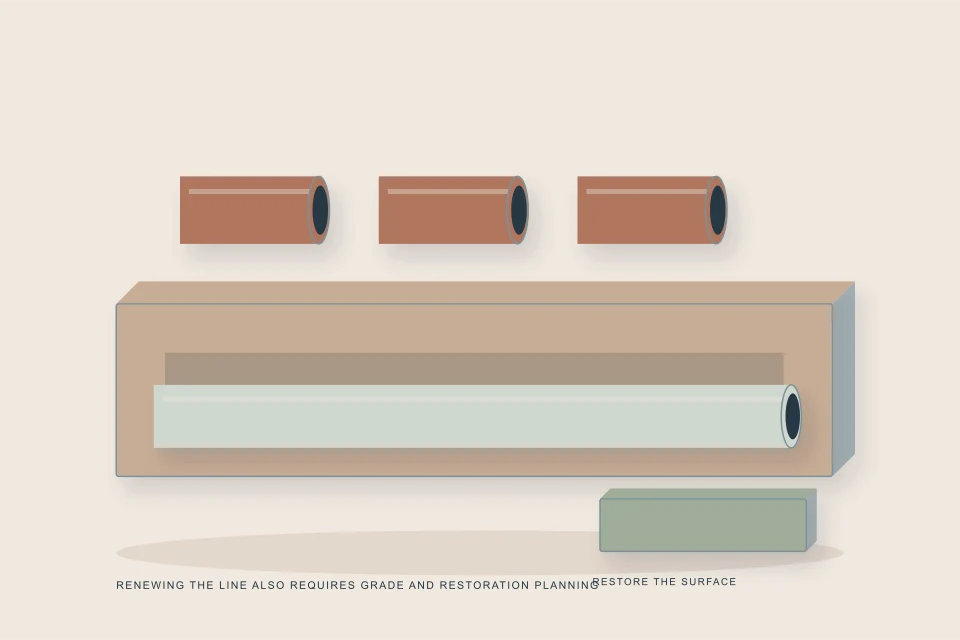
Because it changes the scope. A quote for replacing the line "to the street" may include pipe you do not own and should not pay for, or it may leave out a public-side portion your city expects you to renew. It also affects permits: work in the boulevard or road usually needs municipal permission and sometimes municipal crews.
Planning ranges for private-side work are on the sewer service costs page, with public-side charges listed as extras. When the boundary is confirmed, request quotes for your portion only, and attach the footage. For Calgary specifics, the sister site CalgarySewers.ca covers City service line data in detail.
FAQQuestions people ask
Is the sewer line under the sidewalk my responsibility?
In most cities that split at the property line, no, because the sidewalk and boulevard are usually on municipal land beyond your lot. In Winnipeg, the owner owns the service line all the way to the main, including under the street.
How do I find my property line to know which part of the sewer is mine?
Use your real property report, survey or title plan, which show lot dimensions from the building. Measure along the lateral's route from the foundation. Many lots end behind the sidewalk, not at the curb.
Who is responsible for a shared sewer lateral between two houses?
Usually the owners served by it, jointly, unless an agreement, easement or condominium document says otherwise. Shared laterals are common in some older semi-detached and row houses; check your title and talk to your neighbour before work starts.
Will the city fix my sewer if the blockage is on its side?
Generally yes, where the city owns that portion. Many cities investigate backups to find where the blockage is. Some also reimburse limited costs; Halifax Water, for example, reimburses up to $700 including HST when a plumber's video and report show the blockage was on its side.
In a condo, who pays for a blocked sewer line?
Usually the condominium corporation, when the blockage is in a common drain or the building's service line. Unit owners are typically responsible for drains inside their unit. The declaration and bylaws decide, so contact the property manager first.
NETWORKGo deeper across the HAUSE Sewer network
Whose tree, whose pipe: who pays when roots block a sewer line
Who is responsible when a city or neighbour's tree sends roots into your sewer line: the general Canadian pattern, the evidence, and how to raise it.
SewerQuotes.comSewer permits, inspections and who pays: owner or city?
Sewer line permits and who pays in Canada: the usual owner vs city split, permit and inspection costs, road cuts, city tree roots and what to confirm.
SewerInspector.caLateral defect map: plot your sewer inspection findings
Turn a sewer camera report into a strip map: enter footage-counter distances, defect types and depths to see where each finding sits and how urgent it is.