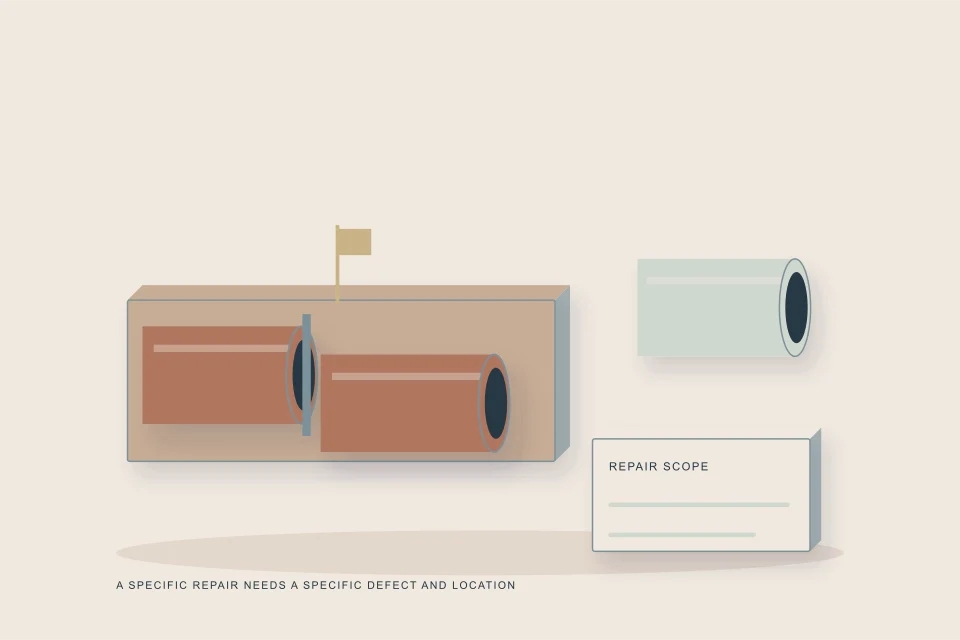
Sewer repair fixes a specific, located defect in an otherwise serviceable line: a cracked or broken section, an offset or separated joint, or a root entry point. It is done either by digging down to that spot and replacing a short length of pipe, or by installing a short sectional liner from inside. It is the right lane when the camera shows one or two problems in sound pipe.
- Repair is for located, limited damage; replacement is for pipe that is failing along its length.
- A spot repair is only as good as the pipe on either side of it, so read the whole video, not just the worst frame.
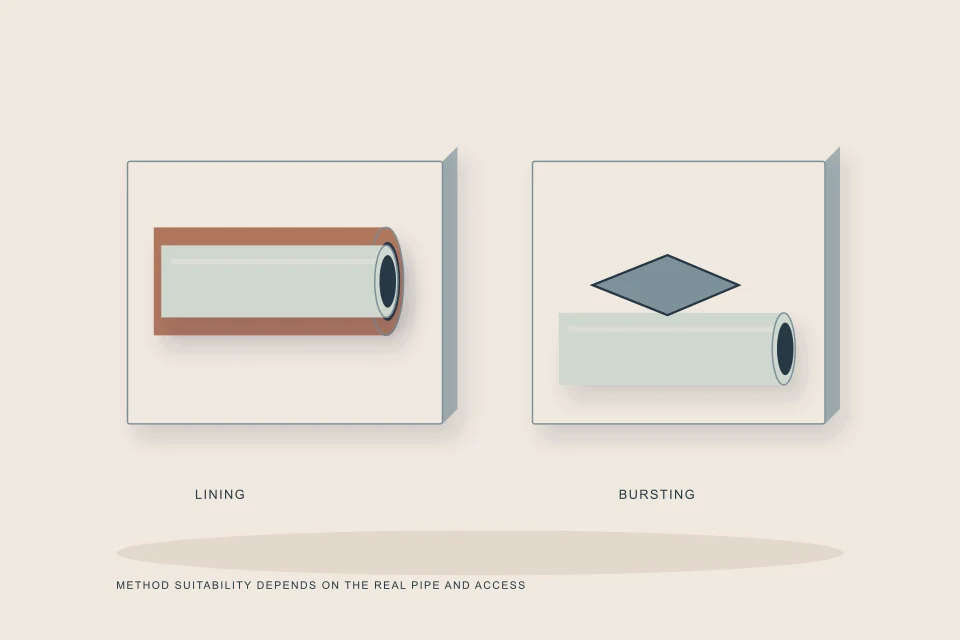
- Sectional liners avoid digging but need a round, reachable pipe; excavation handles breaks and misalignment a liner cannot.
- Transitions between old and new pipe need proper couplings and bedding, or the repair becomes the next defect.
- Several spot repairs on one old line can cost as much as renewing the whole run; price both before deciding.
01 /What sewer defects can be repaired without replacing the line?
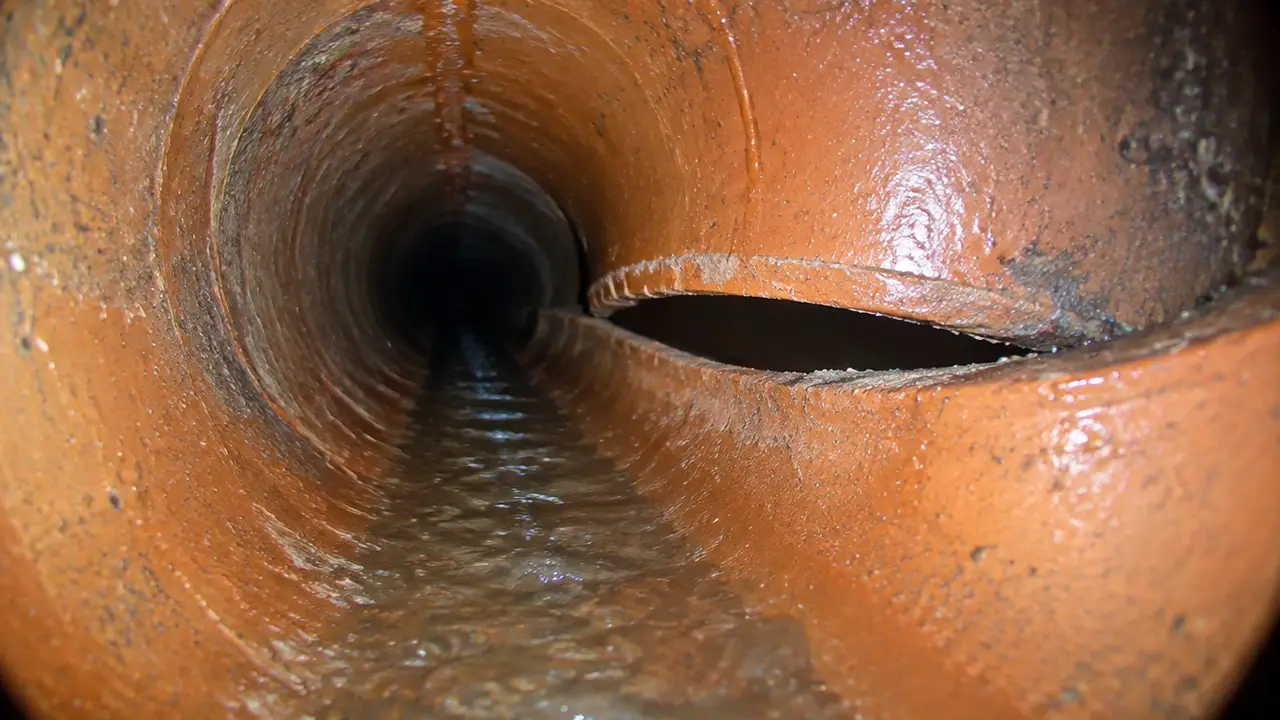
Localized damage in pipe that is otherwise in fair condition is the repair lane's territory. The camera report should give each defect a distance from the access point, and ideally a surface mark and depth. With that, a contractor can dig one small hole or send a short liner to exactly the right place.
| Defect | Spot repair? | Usual method |
|---|---|---|
| Single crack or fracture in sound pipe | Yes | Sectional liner, or dig and replace a short length |
| One offset or separated joint | Usually | Dig and realign; a liner can bridge small offsets |
| Root entry at one or two joints | Yes | Sectional liners over those joints |
| Broken or holed section with soil visible | Yes, by excavation | Dig, replace the section, rebuild bedding |
| Short sag holding water | Sometimes | Dig and re-lay that length on grade |
| Collapse | Only if very short | Excavation; a liner cannot pass it |
| Defects spread along the whole run | No | Trenchless lining or replacement |
02 /Dig-down repair or sectional liner: which fits?
Both fix one location. The choice turns on the pipe's shape at the defect, what sits above it, and how deep it is.
A spot repair suits an isolated fracture, but it does nothing for the pipe on either side of the dig, and that is the key caution. If the video shows one broken joint in a 60-year-old clay line with fine cracks elsewhere, a spot repair fixes today's backup, and the next weak joint may be next year's.
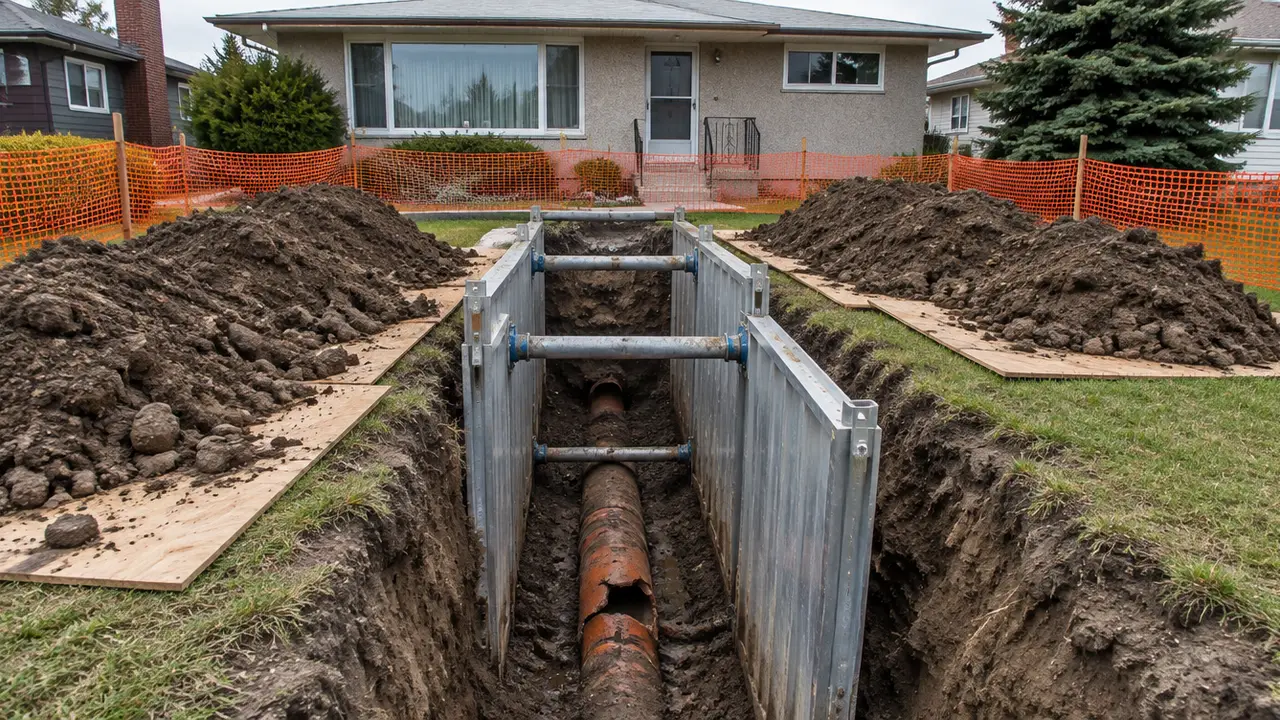
03 /What happens during an excavated sewer repair?
- Mark the spot
The camera's sonde locates the defect at the surface with an approximate depth.
- Locate buried utilities
Request public locates before digging. In Alberta, Utility Safety Partners asks for at least three full working days' notice, and notes that customer-owned lines are not registered, so private locating may be needed too.
- Excavate safely
Deeper holes need shoring, sloping or a trench box. Alberta's Occupational Health and Safety Code has a dedicated part on excavating.
- Replace the section
The damaged length is cut out and new pipe is joined to the old with couplings rated for both materials.
- Bed, inspect, backfill
Granular bedding supports the new section; a permit inspection may be required before backfill; a camera run confirms the result.
Whether a permit is required depends on your municipality and the scope. In Calgary, plumbing permits cover installing, altering or adding to a plumbing system, and homeowners may apply for all permit types except gas. Confirm locally before work starts.
04 /When does repair stop making sense?
The tipping point is usually reached in one of three ways: the number of defects, the material, or the cost curve. A contractor who prices three separate spot repairs on an old clay line should also be asked for a full-length price, because mobilisation and restoration repeat with every dig.
- Defects at many joints along the run suggest the joint material itself has failed.
- Bituminous fibre pipe (often called Orangeburg) deforms along its length; patching one spot rarely helps for long.
- Heavily corroded cast iron can be thin everywhere even where the camera shows only one hole.
- Repeated backups after a repair mean the diagnosis was incomplete.
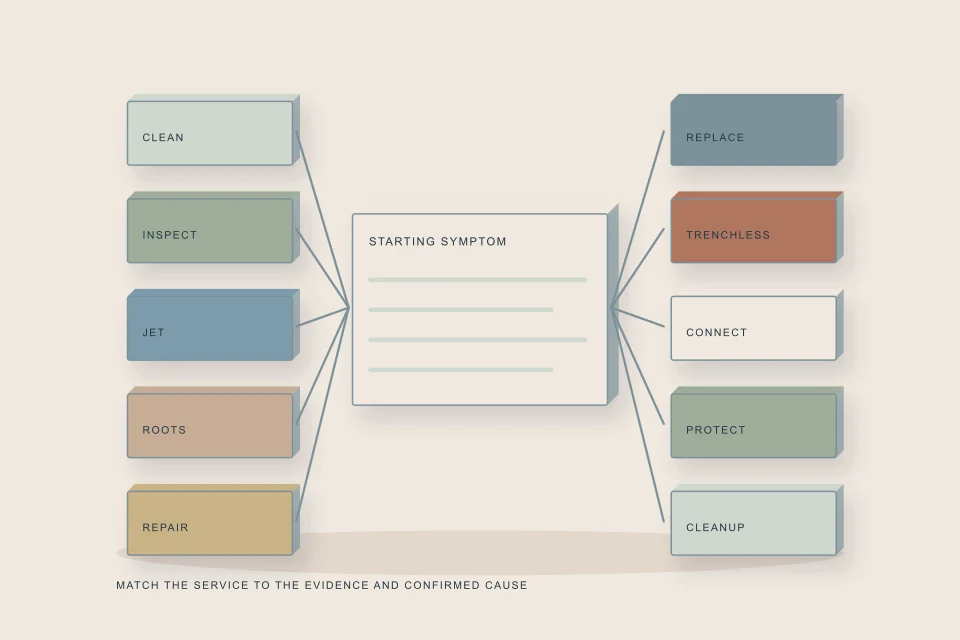
The network's decision site for that crossroads is SewerReplacement.ca, and SewerQuotes.com compares repair and replacement pricing in detail. On this hub, the which sewer service do I need guide shows where repair sits among the ten lanes.
05 /How do frost and winter affect a sewer repair?
Sewer repairs happen year-round in Canada, but winter changes the method and the price. Frozen ground has to be thawed or broken before digging, trench walls behave differently as they thaw, and restoring lawns and concrete may wait until spring.
| Season | What changes | What to ask |
|---|---|---|
| Deep winter | Frost removal, ground thawing, shorter days | Is thawing priced in? Is temporary restoration included? |
| Spring melt | Wet trenches, groundwater, soft ground | How will the trench be dewatered and kept stable? |
| Summer and fall | Easiest digging and restoration | Can a non-urgent repair wait for this window? |
If a defect is serious but the line still flows, some owners keep it cleared through winter and schedule the dig for better ground. That is a judgement for the camera footage and a contractor, not a rule. A collapse or a broken section letting soil in should not wait.
Depth matters for freezing too. A shallow repair, or a section under a cleared driveway where snow cover no longer insulates the ground, can freeze in a cold snap. Ask whether insulation over a shallow repair makes sense, and see the seasonal sewer care guide for winter habits that protect a vulnerable line.
06 /How much does a sewer spot repair cost?
A single excavated spot repair typically plans at $3,500 to $9,000 in 2026 for a typical depth under lawn. Depth and what sits above change it most: the sewer cost estimator shows a deep repair under concrete moving to roughly $6,050 to $16,700. Sectional liners often price per liner, with savings when several are installed on one visit.
- Which defect, at what distance, is this price fixing?
- Is surface restoration included, and to what standard?
- What coupling and bedding will join new pipe to old?
- Is a post-repair camera run included, with the file delivered to you?
- What does the warranty cover, and does it depend on that video?
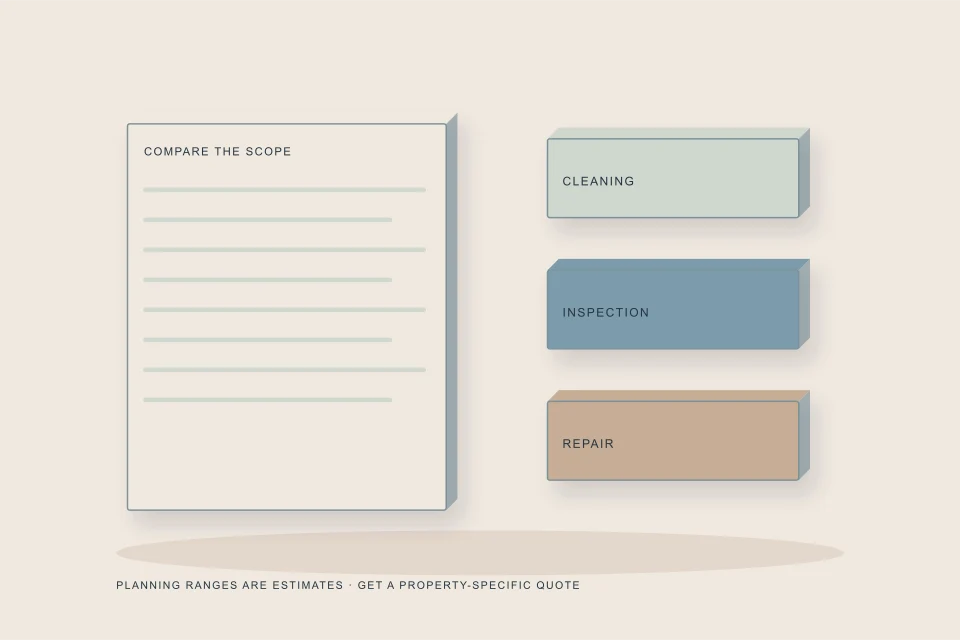
With footage in hand, request a quote and ask for a repair price and a full-length price side by side.
FAQQuestions people ask
Can a single broken section of sewer pipe be replaced?
Yes. If the rest of the line is sound, a contractor can dig down to the broken section, cut it out and couple in new pipe, or install a sectional liner if the pipe is still continuous. The camera footage should confirm the rest of the line is worth keeping.
How long does a sewer spot repair last?
The new section can last as long as a new pipe. The weak point becomes the old pipe on either side, so the useful life of the repair depends on the condition of the line it joins.
Do I need a permit for a sewer spot repair?
Often yes, especially where pipe is replaced. Requirements vary by municipality and by the scope of work, so ask the contractor who pulls the permit and whether an inspection happens before backfill.
Can a sewer be repaired from inside without digging?
Many defects can, using a short cured-in-place sectional liner delivered from a cleanout. It needs a continuous, reasonably round pipe; a collapse, a missing piece or a misaligned joint usually requires excavation.
How many days does an excavated sewer spot repair usually take?
Many residential spot repairs are completed in a day, but depth, frozen ground, locates, permits and inspections can stretch the schedule. Sectional liners are usually faster on site than excavation.
NETWORKGo deeper across the HAUSE Sewer network
Sewer line repair cost: what a spot repair should cost
Sewer line repair cost in Canada for 2026: spot repair and sectional liner planning ranges in CAD, what drives the price, and when a repair beats full replacement.
SewerRoots.caSigns of roots in your sewer line
Signs of roots in your sewer line: gurgling, slow floor drains, seasonal backups and what a camera shows. Ten symptoms ranked, plus how to confirm roots fast.
SewerJetting.caIs hydro jetting safe for PVC and ABS drain pipe?
Can hydro jetting damage PVC or ABS pipe? What plastic lines tolerate, where they are weak (joints, fittings, bellies, heat) and how to jet them safely.