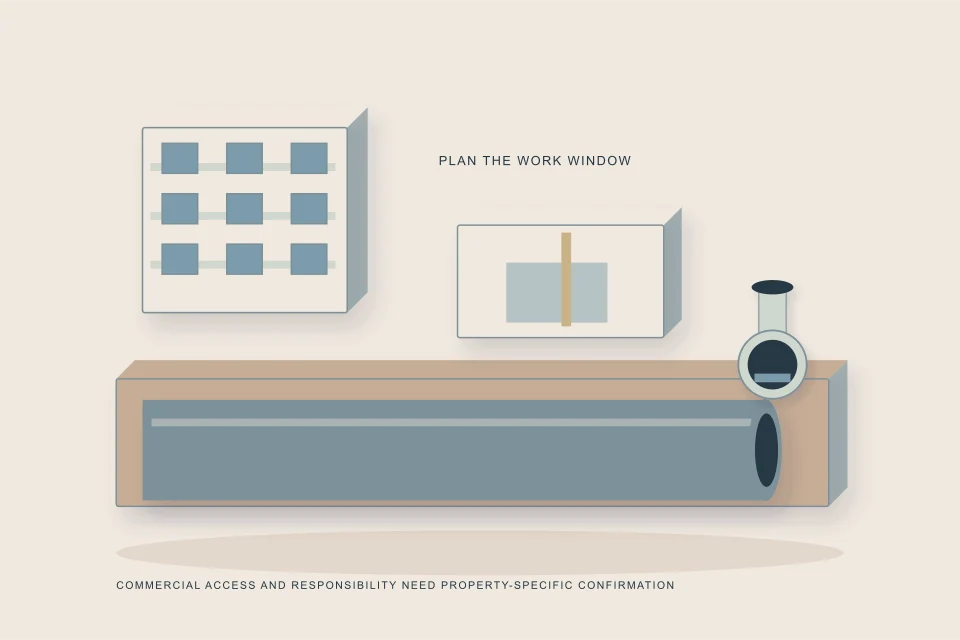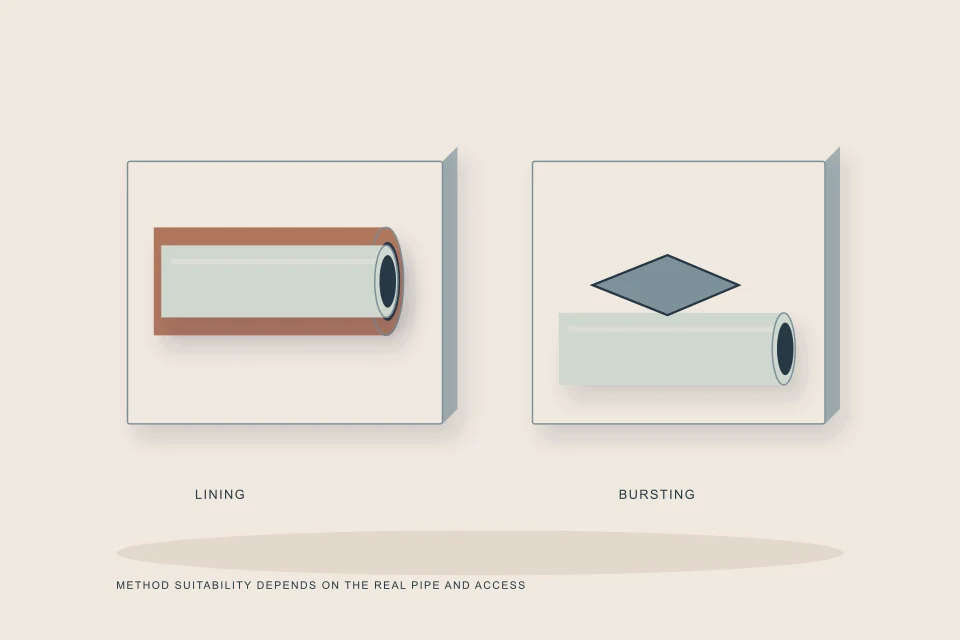
Trenchless sewer repair renews a buried line with little or no trench. Cured-in-place pipe (CIPP) lining installs a resin-saturated liner that hardens inside the old pipe; pipe bursting breaks the old pipe outward while pulling new pipe into its place. Both still need access points, and neither fixes every defect: lining cannot correct a sag or pass a collapse.
- Trenchless means less digging, not no digging; the quote should show every access pit and cleanout.
- Lining needs a continuous, reasonably round host pipe on grade; bursting needs room to expand and a route free of close utilities.
- Neither method is automatically cheaper than open cut; compare complete written scopes including restoration.
- A liner slightly reduces the inside diameter, and branch connections must be reopened from inside.
- Cities use these methods on their own pipes too; Calgary runs a program that lines sanitary service pipes from manholes.
01 /Which sewer problems can trenchless methods fix?
Trenchless methods suit lines whose damage is spread along the run but whose path is still usable. Cracked clay with roots at every joint, cast iron with corrosion holes, and separated joints along a round pipe are classic lining candidates. Brittle pipe that is broken in many places, or a line that needs a larger diameter, may suit bursting.
| Defect on camera | CIPP lining | Pipe bursting |
|---|---|---|
| Cracks and open joints along a round pipe | Good fit | Possible |
| Roots at many joints | Good fit once cut | Possible |
| Corrosion holes in cast iron | Good fit if still round | Possible |
| Sag holding water | Poor; follows the belly | Limited; mostly follows grade |
| Collapse | No; liner cannot pass | Sometimes, if the head can get through |
| Deformed fibre pipe | Poor; copies the deformation | Often a fit |
| Undersized pipe | No; reduces the bore | Good; can often upsize |
| Tight bends | Some bends can be lined | Poor |
If the defects are limited to one or two spots, a short sectional liner or a small dig on the sewer repair lane is usually the cheaper answer. If the line has lost its slope, replacement by open cut is the only method that re-lays it on grade.
02 /How does cured-in-place pipe lining work?
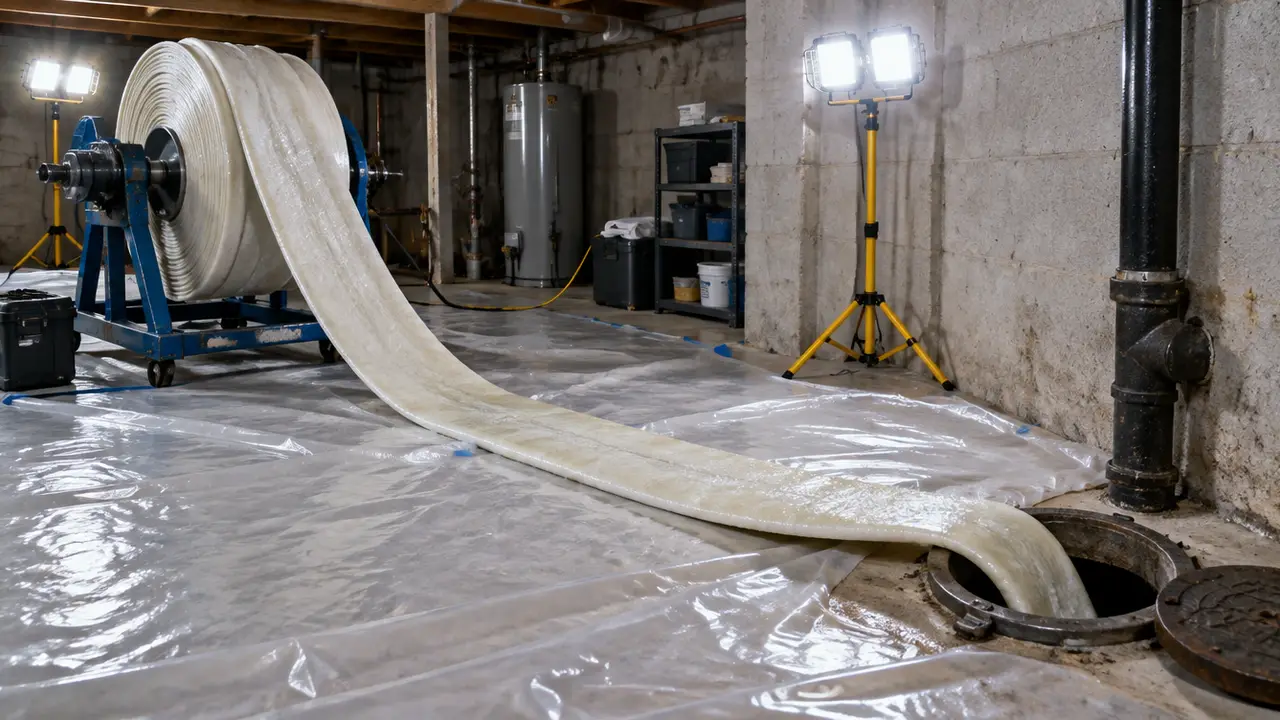
A felt or fibreglass tube is saturated with resin, inserted into the cleaned host pipe by inversion or pull-in, pressed against the wall with air or water, and cured with hot water, steam or ultraviolet light. When it hardens, the result is a jointless pipe inside the old one. Branch connections are reopened with a robotic cutter, and a camera run records the finished liner.
- Camera confirms eligibility
Round, continuous pipe, no collapse, known bends and connections.
- Clean and prepare
Roots, scale and debris are removed so the liner bonds and cures evenly.
- Wet out and install
The liner is saturated with resin and placed through a cleanout or small access pit.
- Cure and reinstate
The resin hardens; connections are cut open again.
- Final video
A post-installation camera run documents wrinkles, fit at the ends, and reopened connections.
Calgary's sanitary lateral lining program shows the same sequence at city scale: assessment by camera, cleaning, liner installation using tools sent through the pipes from manholes, and a final assessment. The City asks residents not to use water during installation and notes the service is out for about three hours.
03 /How does pipe bursting differ from lining?
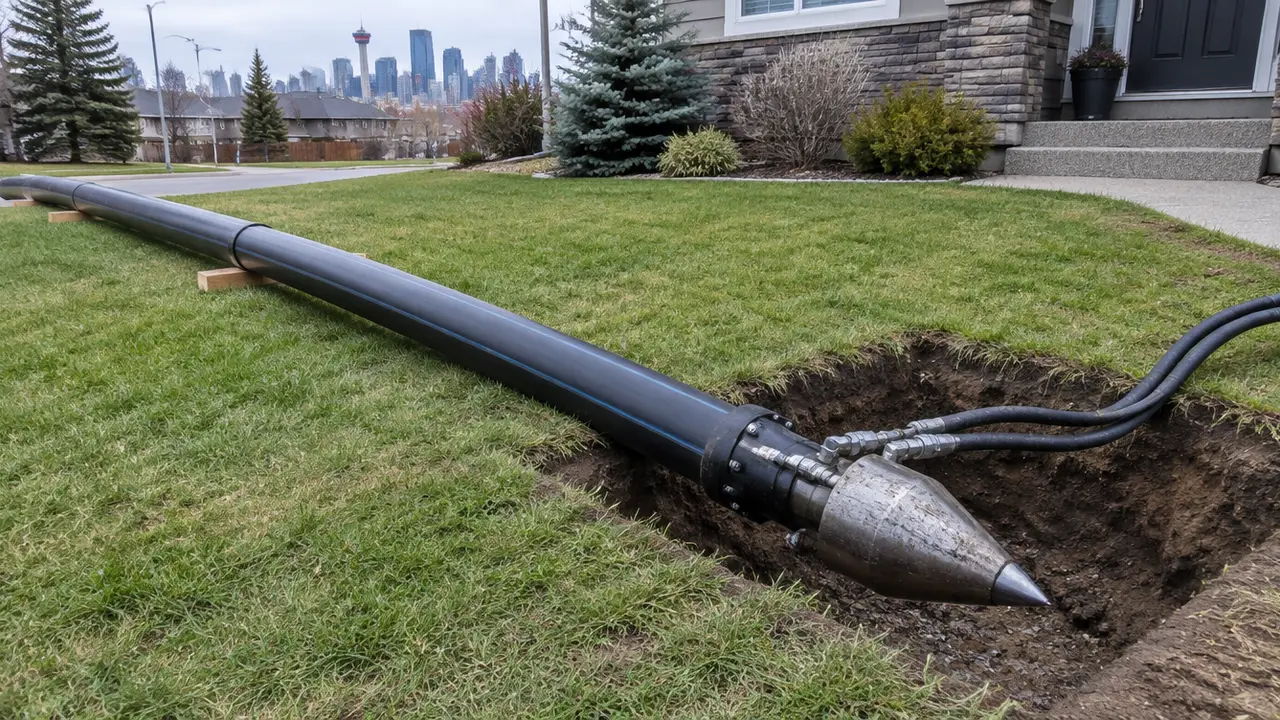
Bursting replaces rather than rehabilitates. A cone-shaped head is winched or pushed through the old pipe from a launch pit to a receiving pit, fracturing the old pipe into the soil and dragging a new pipe, usually fused high-density polyethylene, in behind it. The old pipe stays in the ground as fragments.
Bursting pushes soil outward, so nearby gas, water and communication lines matter. Public utilities are marked through the one-call service in your province, which the national Click Before You Dig portal links to; private lines are not marked by that service.
04 /What should you ask before choosing a trenchless contractor?
- Which method, and why this one for my footage rather than the alternatives?
- Where exactly will you dig access pits, and what restoration is included?
- For lining: what liner and resin, how is it cured, how are branch connections and the liner ends sealed?
- For bursting: what pipe goes in, how are nearby utilities protected, where are the pits?
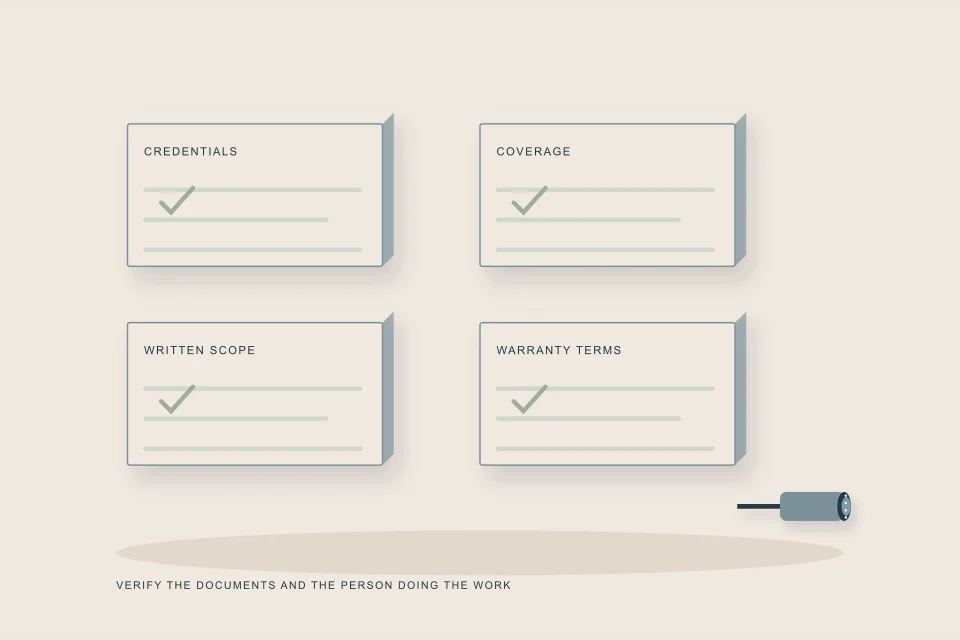
- Will I receive the before and after videos, and does the warranty refer to them?
- What happens if the camera finds a collapse or sag mid-job?
For method-level depth, PipeBursting.ca covers bursting, and SewerReplacement.ca compares lining, bursting and digging. Industry bodies such as NASTT publish training material on CIPP, pipe bursting and laterals.
05 /What does a good trenchless job look like on the final video?
The post-installation camera run is your acceptance test, so watch it with the contractor or ask for the file and a written summary. These are the things to look for:
Keep the before and after videos together with the invoice and warranty. If anything looks wrong, raise it before final payment and ask how it will be corrected. The choosing a sewer contractor guide covers how to build that check into the contract from the start.
06 /What does trenchless sewer repair cost?
For a 15 m residential lateral, full-length CIPP lining plans at roughly $9,000 to $23,500 in 2026, and pipe bursting at roughly $10,000 to $24,500 before surface restoration. Lining's advantage shows under driveways, slabs and mature trees, where it avoids the restoration costs that open cut and bursting pits carry.
When the footage shows a round, continuous line with damage along its length, request a trenchless quote and ask the desk for an open-cut price alongside it.
FAQQuestions people ask
Is trenchless sewer repair as good as a new pipe?
A well-designed, well-installed liner or burst pipe can perform like new pipe, but results depend on the product, the host pipe and the installation. Ask for the material specification, the final video and the written warranty terms.
Can a trenchless liner go around bends in a sewer?
Some bends can be lined, depending on the angle, the liner and the access. Tight or multiple bends may rule it out. The contractor needs camera evidence of the bends before committing.
Will lining or bursting correct a belly in the line?
Not reliably. A liner takes the shape of the pipe it is cured in, including the low spot, and bursting mostly follows the existing grade. Correcting a sag usually requires excavating and re-laying that section.
Does trenchless repair work in winter in Canada?
Often yes, since the work is underground, but frozen access pits, cold resin handling and site conditions can affect scheduling. Ask the contractor about their cold-weather procedures.
Does a liner reduce flow in my sewer line?
It reduces the inside diameter by the liner's thickness, while the smooth, jointless surface can offset some of that. On a typical residential line the change is rarely a problem, but ask for the design assessment.
Will the city line my service pipe for me?
Some cities line their own portion of service pipes. Calgary runs a sanitary lateral lining program from manholes, for example. Whether your private portion is included is a question for your municipality.
How long does a residential sewer liner installation take?
Many residential lining jobs are completed in a day on site, including cleaning, installation, curing and reinstating connections, though long runs, several branches or difficult access can stretch it. Calgary's own program notes a sewer connection is out of service for about three hours during its liner installation.
NETWORKGo deeper across the HAUSE Sewer network
Trenchless lining vs pipe bursting: cost, fit and trade-offs
Trenchless lining vs pipe bursting cost in Canada: 2026 CIPP and bursting ranges in CAD, line items, which defects each fixes and how to choose.
SewerCleaners.caHow to hire a sewer cleaner: the checklist, the questions and the paperwork
How to hire a sewer cleaner in Canada: questions to ask, insurance and WCB coverage in Alberta, a written scope template, red flags, and how to compare quotes.
SewerRoots.caSewer root removal cost in Canada: cutting, chemicals and permanent fixes
Sewer root removal cost in Canada for 2026: planning ranges for cable cutting, jetting, camera, lining, bursting and replacement, plus cycle-versus-fix math.