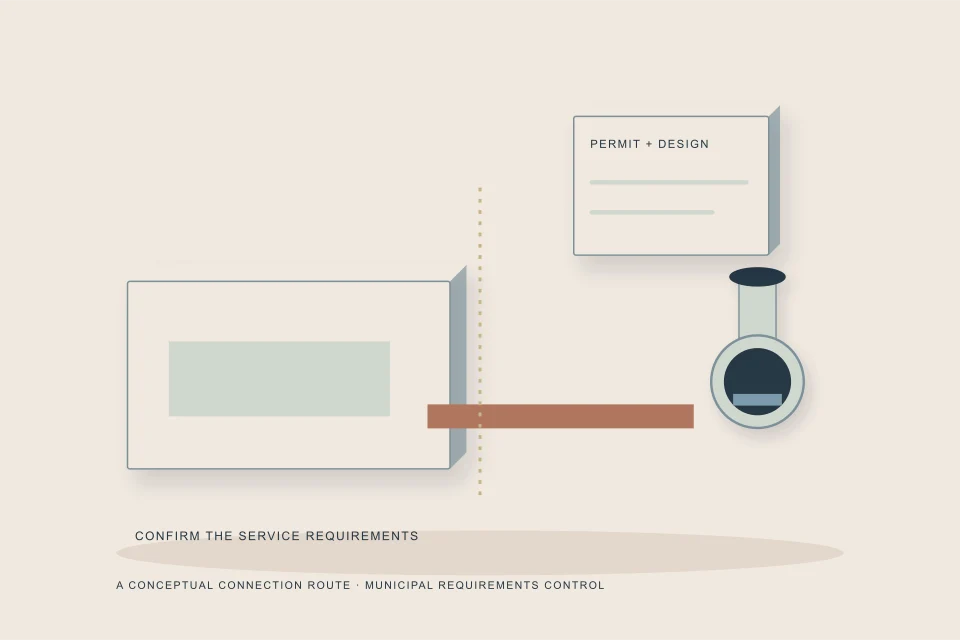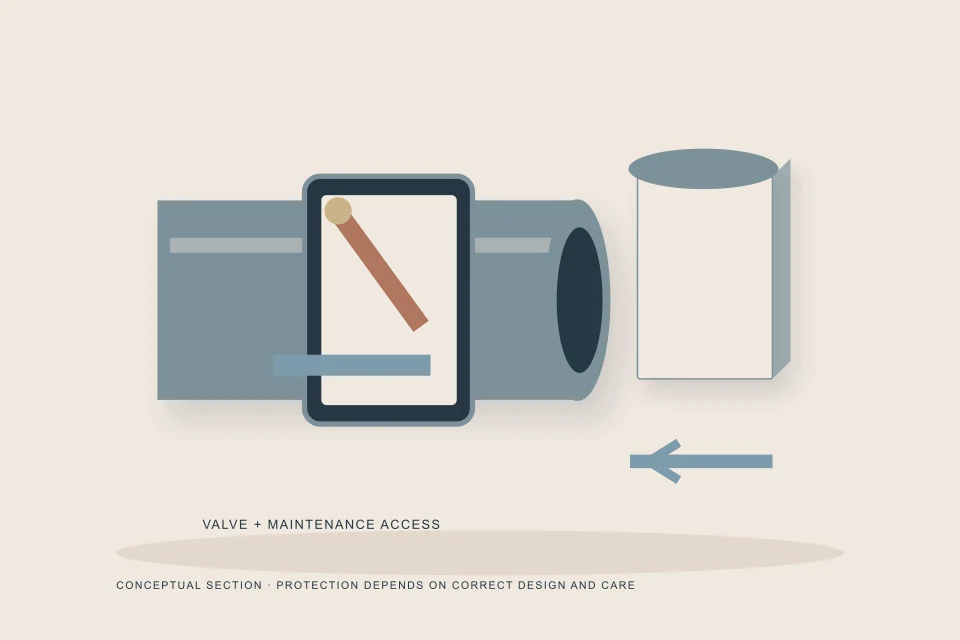
A backwater valve is a one-way valve on the main sanitary drain that lets wastewater leave the house but closes when sewage in the municipal main surges back toward it. It protects basements from sewer backups caused by a surcharged city sewer. It does not stop a blockage in your own line, it needs yearly cleaning, and while it is closed you must not use water.
- A backwater valve protects against backflow from the main, not against a clog in your own lateral.
- Older homes often lack one; EPCOR notes Edmonton homes built before 1989 were not required to have them.
- Installation usually means breaking the basement floor and needs a permit and inspection.
- When the flap is closed, water used upstairs has nowhere to go but the floor drain, so stop using water during a backup.
- Subsidies exist in some cities: as checked September 2026, Toronto offers up to $1,600 per valve and EPCOR up to $800 in Edmonton, each with conditions.
01 /How does a backwater valve work?
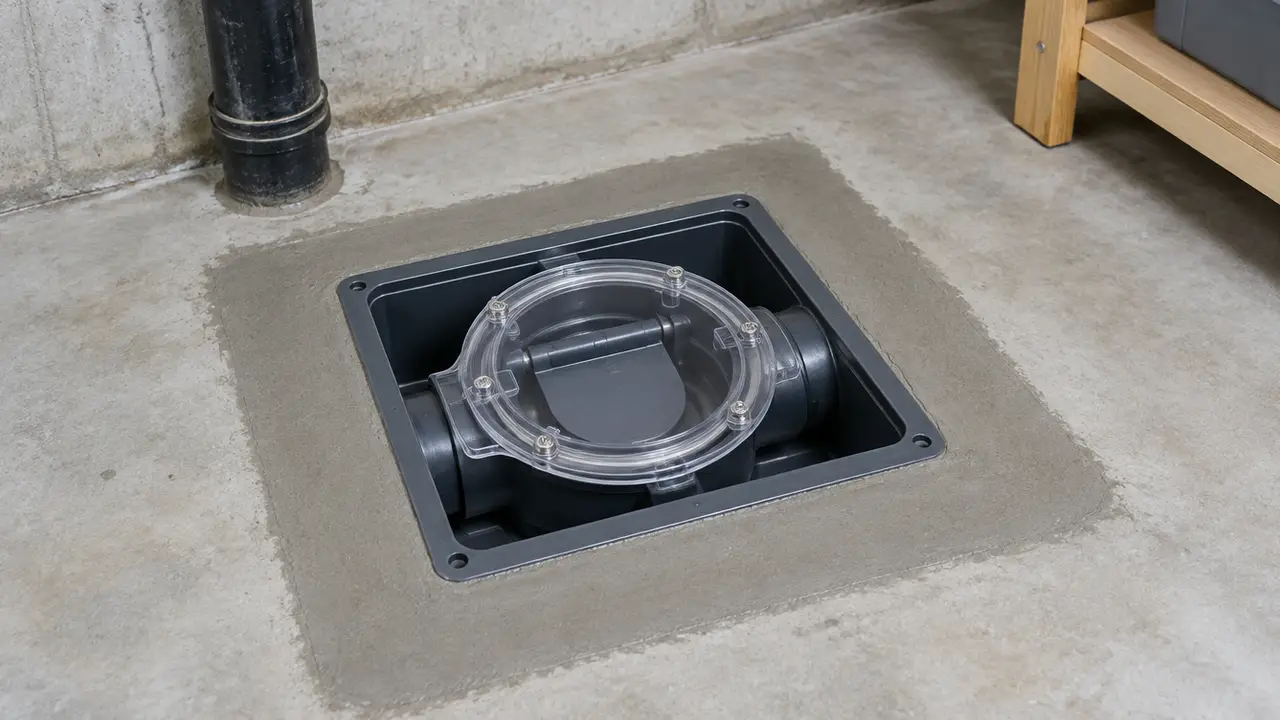
Inside the valve body is a flap or gate that normally hangs open so wastewater flows out by gravity. When water in the municipal sewer rises high enough to push back up the lateral, it lifts the flap shut against its seat and seals the line. When the surge drops, the flap falls open again. EPCOR describes the device as sitting on the main sanitary sewer pipe to stop sewage flowing back from the mainline.
The National Plumbing Code of Canada requires backflow protection where a building drain or branch may be subject to backflow, on fixtures located below the level of the adjoining street, and permits a single normally-open valve in the building drain for one dwelling unit. Provinces adopt and sometimes amend the model code, so the exact requirement is a question for your local permit office.
02 /Who needs a backwater valve?
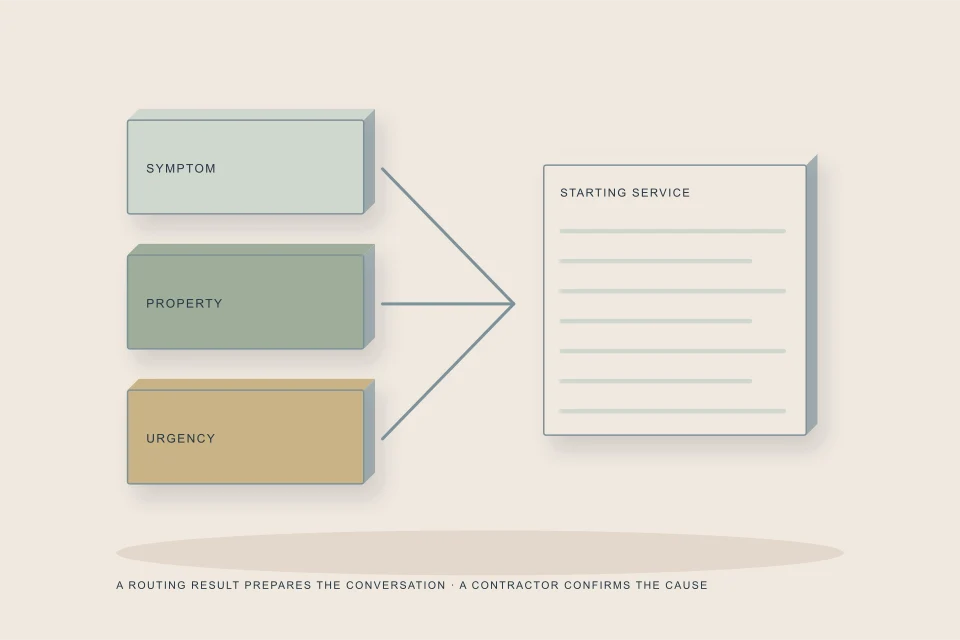
Any house with plumbing fixtures or a floor drain below street level is a candidate, and the case is strongest where the neighbourhood has flooded before, where the sewer is combined or older, or where the home was built before valves were routinely required. The service selector adds this lane whenever the symptom is water or sewage coming up a floor drain.
| Situation | Valve helps? | Also consider |
|---|---|---|
| Sewage rose from the floor drain during a storm | Yes, if the main surcharged | Downspout disconnection; sump for foundation water |
| Backup happened in dry weather | Maybe not; likely your own line | Drain cleaning and a camera |
| Older home, finished basement, no valve | Often worth pricing | Your city's subsidy rules |
| Valve installed but basement flooded anyway | Check it: stuck open, debris, or water used while closed | Maintenance and a camera |
| Groundwater seeping through walls | No | Grading, sump pump, foundation work |
03 /How is a backwater valve installed?
- Find the main drain
A camera and locator identify where the building drain runs under the floor, and whether other fixtures join it.
- Permit
Most municipalities require a plumbing or building permit; Toronto's subsidy requires a building permit and inspection before the valve is enclosed.
- Break the floor
A section of basement slab is cut and excavated to expose the drain.
- Install and slope
The valve is set level with the right fall on either side; the Insurance Bureau of Canada's advice mentions installing it with at least a 2% grade.
- Access box and inspection
A removable cover over the valve allows cleaning; the inspector checks before the floor is patched.
A licensed plumber is the norm and is a condition of several subsidy programs. EPCOR's subsidy requires installation by a professional plumber and the City of Edmonton inspection sticker with permit number when applying.
04 /How do you maintain a backwater valve?
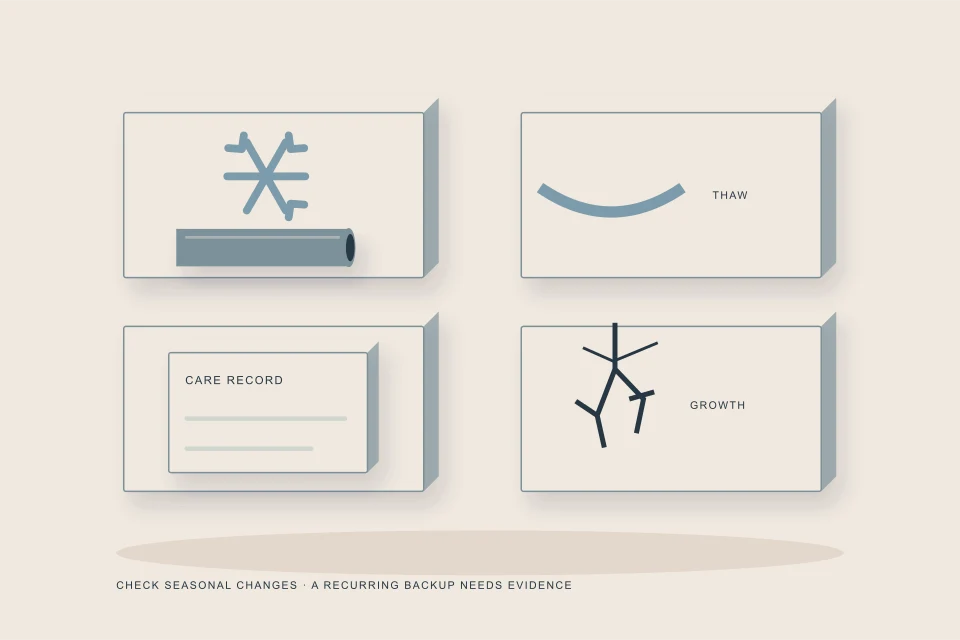
Open the access cover at least once a year, and before the spring melt and storm season, to confirm the flap moves freely and nothing is caught under it. The Insurance Bureau of Canada recommends maintaining the valve at least once a year. EPCOR's homeowner steps are to remove the plug, look inside with a flashlight for debris, flush with water, move the gate to check it moves, inspect the O-ring and replace the plug.
- Keep the access cover reachable; do not tile or carpet over it.
- Check after any work on the main line, since debris can lodge in the valve.
- Replace damaged seals and missing covers promptly.
- Keep a note of each check with your house records.
05 /What are the most common backwater valve mistakes?
Most failures come down to placement, access or habits rather than the valve itself. These are the patterns worth checking on an existing installation or asking about before a new one:
- Valve in the wrong place. Any below-grade fixture that drains into the line downstream of the valve, or on a separate branch without its own valve, is left unprotected.
- Buried access. A valve sealed under flooring cannot be cleaned, and a flap held open by a scrap of debris protects nothing.
- Downspouts connected to the sewer. Roof water sent into a sanitary or combined sewer adds to the surge; the Insurance Bureau of Canada recommends disconnecting them.
- Using water during a storm backup. With the flap shut, upstairs water rises through the floor drain.
- Assuming a valve exists. Many older houses never had one; a camera run or a look under the access cover settles it.
- Treating it as a blockage fix. Dry-weather backups point to your own line, not the city's.
A valve works best as one layer of protection. Lot grading that sheds water away from the foundation, downspouts extended away from the house, and a working sump where foundation drainage needs one all reduce the load on the system. Calgary's basement flooding guidance, for example, suggests positioning downspouts at least six feet from the foundation. The seasonal sewer care guide puts these checks into a calendar.
06 /What does a backwater valve cost, and are subsidies available?
Retrofit installation in an existing basement typically plans at $1,800 to $4,500 in 2026, and more in a finished basement, where the sewer cost estimator adds $500 to $1,500 for extra floor removal and finishing. Subsidies can cover a large share where they exist.
| City | Program amount | Key conditions |
|---|---|---|
| Toronto | Up to 80% of invoiced cost, max $1,600 per valve, up to two valves | Building permit and inspection; work on or after Nov 12, 2025; apply within two years |
| Edmonton (EPCOR) | Up to $800 | Home built before 1989; flooding history or neighbourhood flooding; no existing valve; plumber-installed; funding-limited |
For the cleanup side of a backup, see the sewage cleanup lane or SewageCleanup.ca. For detailed installation pricing, SewerQuotes.com compares quotes. The across Canada page lists how other cities handle backups. Ready to price one? Send a request.
FAQQuestions people ask
Does a backwater valve stop all basement flooding?
No. It stops sewage flowing back from a surcharged municipal sewer. It does not stop a blockage in your own line, groundwater seeping through the foundation, or overland water coming in through windows and doors.
How often does a backwater valve need checking?
At least once a year is the common recommendation, ideally before spring melt and storm season, and after any work on the main line. Check that the flap moves freely and that no debris is caught at the seat.
Is installing a backwater valve a DIY job?
It involves cutting the basement slab, working on the main drain and meeting code, and most municipalities require a permit and inspection. Several subsidy programs also require a licensed or professional plumber, so doing it yourself can cost you the rebate.
Why did my basement flood even though I have a backwater valve?
Common reasons are debris holding the flap open, a valve that was never maintained, water being used upstairs while the valve was closed, or a blockage in your own lateral that the valve cannot address.
Does a backwater valve lower home insurance premiums?
Some insurers consider protective devices when offering sewer backup coverage or setting terms, but practices vary. Ask your insurer directly, and keep the permit and installation invoice.
Is a backwater valve required in new homes?
Current plumbing codes call for backflow protection on fixtures below the level of the adjoining street where backflow is possible, and permit offices enforce the provincial version. Confirm the local requirement when you apply for a permit.
NETWORKGo deeper across the HAUSE Sewer network
Backwater valve installation cost and municipal subsidies
Backwater valve installation cost in Canada for 2026: CAD ranges for unfinished and finished basements, line items, subsidy program patterns and insurance angles.
SewerCleaners.caBackwater valves: how they work and how to maintain one
How a backwater valve works, normally open vs normally closed types, a step-by-step maintenance routine, and what to do when it closes in a storm.
DrainAugering.caClog Locator: find the blockage before you pick up a cable
Use the Clog Locator to find where a drain clog sits (trap, branch, stack, main or lateral) and which auger class and cable size fits the pipe.