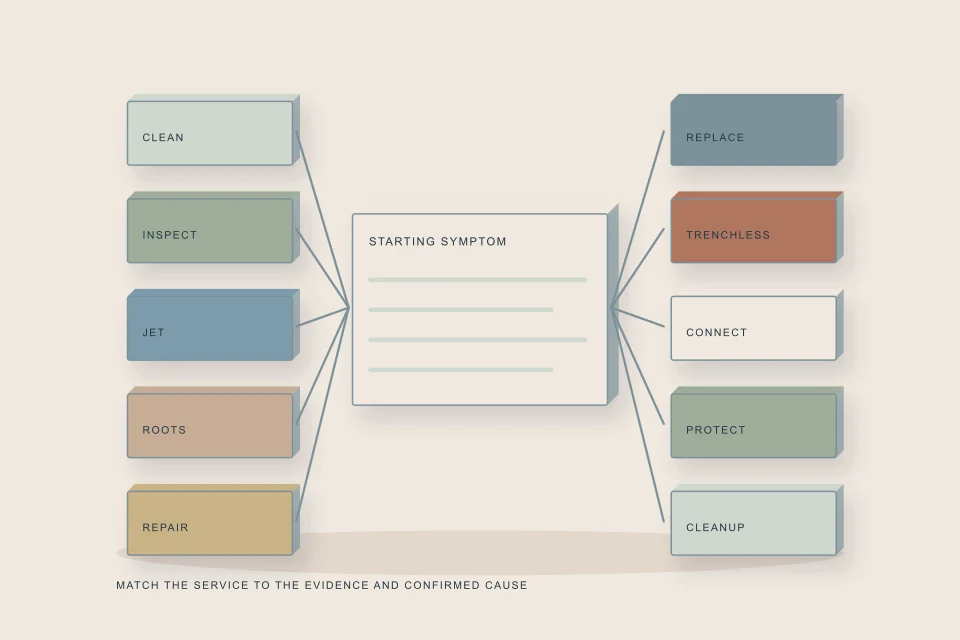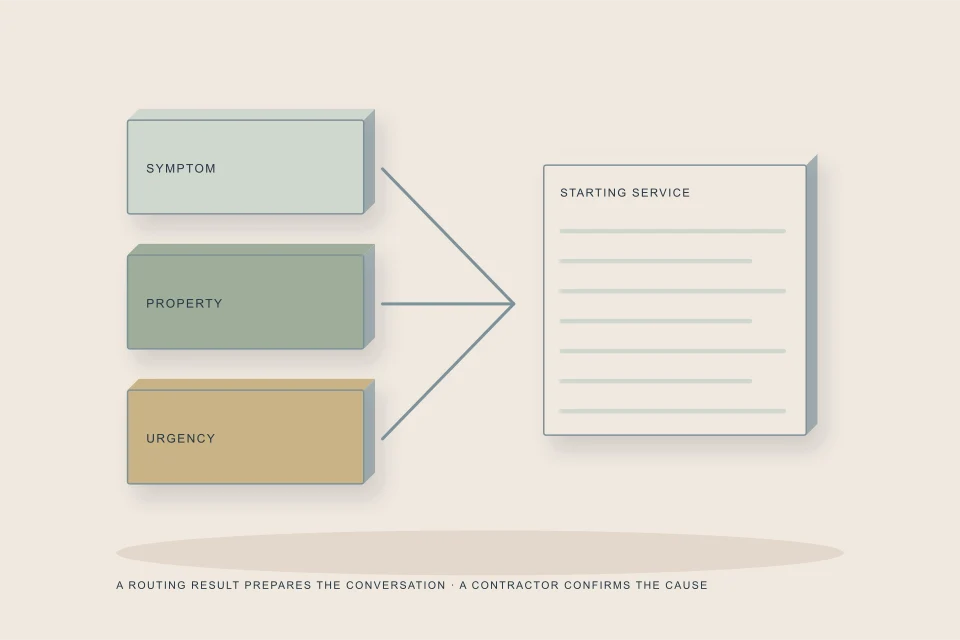
The Sewer Service Selector asks three questions: what is happening, what kind of property it is, and how urgent it is. It maps the symptom to one, two or three of the ten service lanes, names the one to start with, explains why, and links each lane to its page. It adds notes for condos and commercial buildings, and a safety warning for active backups.
- Ten symptoms map to the ten service lanes; the first lane listed is where to start.
- Condo and townhouse results add a reminder that shared lines are often the corporation's responsibility.
- Commercial results add a note that access, business hours and grease rules shape the work.
- A "Right now" warning appears for a floor-drain backup, several slow drains or an after-backup situation when you choose "Happening now".
- It is a routing guide, not a diagnosis; a camera and a qualified contractor confirm what is wrong.
Sewer Service Selector
01 /How does the Sewer Service Selector work?
The selector is a lookup, not a guess. Each of its ten symptoms is tied to a fixed list of service lanes, drawn from how sewer problems usually unfold. The first lane in the list appears as "Start with" and is marked First; any others appear as "Then, if needed". Each lane links to its page on this site, where the method, limits and costs are explained.
- What is happening?
Choose the closest of ten symptoms, from a single slow fixture to a contaminated basement after a backup.
- Property
House, condo or townhouse, or commercial or multi-unit.
- How urgent
Happening now, this week, or planning ahead.
- Read the result
The lane to start with, a one-line reason, the follow-on lanes, any property note, and the safety warning if it applies.
Nothing you enter is sent anywhere. The result appears on the page and changes as soon as you change an answer.
02 /Which service does each symptom lead to?
This is the complete mapping the tool uses. Reading it directly is useful if two symptoms apply at once, for example a smell and recurring clogs.
| Symptom in the selector | Start with | Then, if needed | Why |
|---|---|---|---|
| One fixture drains slowly | Drain or main line cleaning | None | Usually a local clog in that fixture's drain, not the main |
| Several drains are slow at once | Drain or main line cleaning | Camera inspection | Points to the main; clear it, then film it to see why |
| Water or sewage is coming up a floor drain | Drain or main line cleaning | Sewage backup cleanup; backwater valve | Main blocked or city side surcharging; stop using water |
| Sewer smell indoors | Camera inspection | None | Rule out dry traps, vents and wax rings first |
| Clogs keep coming back | Camera inspection | Hydro jetting | Find the cause: roots, a sag, grease or a break |
| Roots were found in the line | Root removal | Sewer repair | Cutting buys time; sealing the joints lasts |
| Buying a house | Camera inspection | None | Shows the line's material and condition before your deadline |
| A camera found cracks, a sag or a collapse | Sewer repair | Sewer replacement; trenchless repair | Defect type and location decide the method |
| Planning a new build, infill or new connection | New sewer connection | None | Permits, locates and municipal sign-off need lead time |
| The backup is cleared but the basement is contaminated | Sewage backup cleanup | None | Safety, removal of porous materials, disinfection, drying |
Every lane named in the table has its own page: camera inspection, drain cleaning, hydro jetting, root removal, sewer repair, sewer replacement, trenchless repair, new sewer connection, sewage cleanup and backwater valves.
03 /What do the property and urgency answers change?
They never change the lanes. They add context that affects who you call first and how quickly.
| Answer | What appears | Why it matters |
|---|---|---|
| Condo or townhouse | Check with the property manager or board first; shared lines are often the corporation's responsibility | Booking your own contractor on a common line can create cost and liability disputes |
| Commercial or multi-unit | Access, business hours and grease rules shape the work; say so when asking for quotes | Scheduling, tenant notice and interceptor rules affect price and method |
| House | No extra note | Responsibility usually runs from the house to the property line; confirm locally |
| Happening now, with a floor-drain backup, several slow drains, or after a backup | A "Right now" warning: stop using water, keep people away from sewage, stay clear of wet electrical equipment | These are the situations where continued water use or contact causes harm |
| Happening now, other symptoms | No warning | A smell or a slow sink is not an emergency on its own |
| This week or planning ahead | No warning | Time to gather footage and compare quotes |
04 /Why does the selector send some symptoms to a camera first?
Because for those symptoms, any other first step risks paying for the wrong work. A smell with full traps, clogs that keep returning, and a house you are about to buy all have causes that cannot be seen from inside the house. The camera sets the direction for everything after it.
The smell entry carries a specific caution: dry traps, failed vents and toilet wax rings cause many indoor sewer smells and cost little to fix. Pour water into rarely used floor drains and check the toilet base before booking. If the smell persists with full traps, the camera is the next step. The how a home sewer system works guide explains traps and vents.
05 /How do you use the selector when two symptoms apply?
Run each symptom separately and merge the lanes, keeping the most urgent first. The order in the merged list matters more than any single result.
| Symptoms together | Merged order | Reason |
|---|---|---|
| Several slow drains and a sewer smell | Cleaning, then camera | Restore flow, then find the cause of both |
| Recurring clogs and roots found | Root removal, camera, repair | Clear the roots, then map the entry points |
| Floor-drain backup and buying a house | Tell the seller; camera before the deadline | The backup is evidence; the footage settles it |
| After a backup and recurring clogs | Cleanup, then camera, then jetting or repair | Make the space safe, then fix the cause |
If the merged list includes cleaning and the problem is happening now, cleaning goes first regardless of anything else.
06 /What are the selector's limits?
- It cannot see your pipe. It maps symptoms to the usual sequence, and a camera finding overrides it.
- It takes one symptom at a time. If two apply, run both and combine the lanes.
- It does not judge who is responsible. Municipal boundaries vary; see who owns the sewer line.
- It does not price anything. For planning ranges, use the companion sewer cost estimator.
- It is not an emergency service. HAUSE Sewer is an independent information and service-request network, not a contractor.
For a fuller comparison of the lanes, including the usual order in which they happen, read which sewer service do I need. When you know where to start, send the result and your symptoms to the desk.
FAQQuestions people ask
Is the Sewer Service Selector a diagnosis?
No. It is a routing guide that maps a symptom to the service lanes that usually address it. A camera inspection and a qualified contractor confirm what is actually wrong with a specific pipe.
Why does a floor-drain backup show three services?
Because three separate jobs usually follow: clearing the line so sewage stops coming in, cleaning up the contamination, and then considering a backwater valve if the city sewer surcharged. Each is a different trade.
Why does a sewer smell lead only to a camera inspection?
Because the likely causes are either cheap fixes inside the house, such as a dry trap or a failed toilet seal, or defects in the line that only a camera can locate. Rule out the cheap fixes first, then film the line.
What if my symptom is not in the list?
Choose the closest one and read the linked service pages, or describe the situation to the HAUSE Sewer desk through the quote form, including the age of the house and anything already found.
Does the selector change its answer for condos?
The service lanes stay the same, but it adds a note to check with the property manager or board first, because shared lines in condominiums and townhouses are often the corporation's responsibility.
Why does roots lead to repair as the second step?
Cutting roots restores flow but leaves the open joints they grew through. The selector lists sewer repair second so that sealing those joints, with sectional liners, a full liner or a dig, is planned rather than forgotten until the next backup.
NETWORKGo deeper across the HAUSE Sewer network
Clog Locator: find the blockage before you pick up a cable
Use the Clog Locator to find where a drain clog sits (trap, branch, stack, main or lateral) and which auger class and cable size fits the pipe.
PipeCleaning.caCondo and apartment drain stack cleaning
Condo and apartment drain stack cleaning: why kitchen stacks back up on lower floors, how stacks are jetted or descaled, and how boards schedule it.
SewerJetting.caJet or auger? A decision tool for your blocked line
Jet or auger decision tool: enter blockage type, pipe material, camera findings, pipe size and access to see whether to jet, auger or camera first.