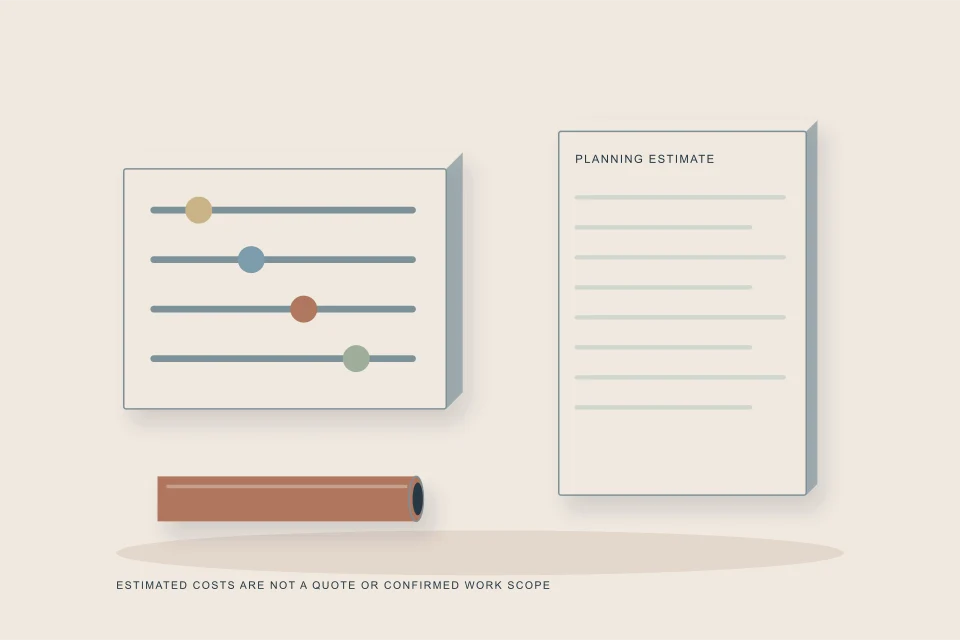
The Sewer Cost Estimator gives a 2026 planning range in Canadian dollars for eight common sewer jobs, from cable cleaning to full lateral replacement. You set the job, pipe length, depth, what is on top of the line, whether a cleanout exists and whether it is an emergency. It lists every factor that moved the range. It is a planning aid, not a quote.
- Service calls (cleaning, jetting, camera, backwater valve) start from a fixed visit range; lining, bursting and open cut scale with metres of pipe.
- Depth multiplies dig jobs by 0.9 for shallow lines and 1.3 for deep ones; lining is unaffected because it needs no trench.
- Hard surfaces and finished basement floors add the most: up to $5,000 and $6,000 on the high end.
- No cleanout adds $150 to $450 to any job, and after-hours service calls are multiplied by 1.4 to 1.6.
- Every number is a planning estimate from editorial assumptions; real quotes depend on what the camera and the site show.
Sewer Cost Estimator
01 /What does the Sewer Cost Estimator include?
It covers the eight sewer jobs homeowners most often need to budget for. Four are priced as service visits with a fixed starting range; one is a single-location dig; three are full-length jobs priced per metre on top of a setup cost. These are the exact starting figures the tool uses.
| Job in the estimator | How it is priced | Starting range |
|---|---|---|
| Main line drain cleaning (cable) | Service visit | $200–$450 |
| Hydro jetting | Service visit | $400–$900 |
| Camera inspection + locate | Service visit | $250–$600 |
| Backwater valve installation | Service visit, floor-dependent | $1,800–$4,500 |
| Spot repair (one section, open dig) | Single dig | $3,500–$9,000 |
| Full lateral replacement — open cut | Setup $4,000–$8,000 plus $500–$1,100 per metre | At 15 m: $11,500–$24,500 |
| Trenchless lining (CIPP) | Setup $3,000–$7,000 plus $400–$1,100 per metre | At 15 m: $9,000–$23,500 |
| Trenchless pipe bursting | Setup $4,000–$8,000 plus $400–$1,100 per metre | At 15 m: $10,000–$24,500 |
02 /How does each input change the range?
The tool applies its adjustments in a fixed order, and the result lists each one that applied, so you can see exactly why two scenarios differ.
| Input | Options | Effect on the range | Applies to |
|---|---|---|---|
| Length of pipe | 3 to 40 m, default 15 m | Per-metre rate times length, plus setup | Open cut, lining, bursting |
| Depth | Shallow (under ~1.5 m), typical (~1.5–2.5 m), deep (over ~2.5 m) | × 0.9, × 1.0 or × 1.3 | Spot repair, open cut, bursting |
| What is on top | Lawn or soil; landscaping, trees, fences; driveway, sidewalk or concrete; finished basement floor | +$0; +$500–$2,000; +$1,500–$5,000; +$2,000–$6,000 | Spot repair, open cut, bursting |
| Finished basement floor | Same surface choice | +$500–$1,500 | Backwater valve only |
| Access | Usable cleanout, or none (toilet pull or roof vent) | No cleanout: +$150–$450 | Every job |
| Timing | Scheduled business hours, or emergency / after hours | After hours: low × 1.4, high × 1.6 | Cleaning, jetting, camera, backwater valve |
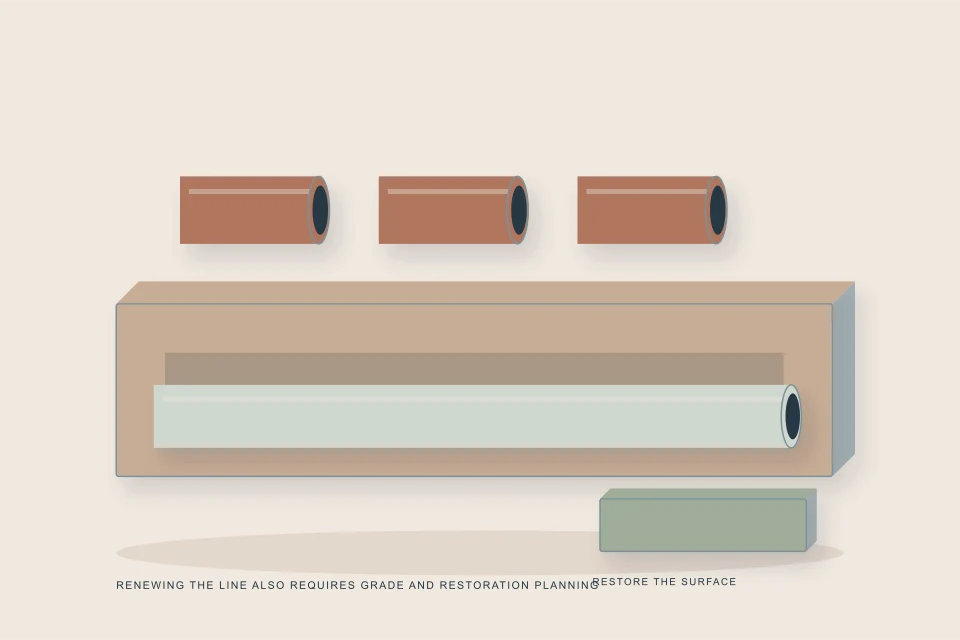
Two details are easy to miss. Lining ignores depth and surface entirely, because it works through a cleanout or small access pits; the tool notes that lining usually avoids surface restoration. And for any job with digging or length, the result reminds you that permits and inspections are usually extra and set by your municipality.
03 /What do some real scenarios come out to?
These worked examples use the estimator's own arithmetic, rounded as the tool rounds: to the nearest $50 above $1,000 and the nearest $10 below.
| Scenario | Inputs | Planning range |
|---|---|---|
| Weekend main line clog, no cleanout | Cable cleaning, no cleanout, after hours | $490–$1,450 |
| Grease-coated line | Hydro jetting, cleanout, scheduled | $400–$900 |
| Pre-purchase camera | Camera + locate, cleanout, scheduled | $250–$600 |
| Valve in a finished basement | Backwater valve, finished basement floor, scheduled | $2,300–$6,000 |
| Deep break under the driveway | Spot repair, deep, concrete | $6,050–$16,700 |
| Standard lateral replacement | Open cut, 15 m, typical depth, lawn | $11,500–$24,500 |
| Replacement under a driveway | Open cut, 15 m, deep, concrete | $16,450–$36,850 |
| Lining the same line | CIPP, 15 m, any depth or surface | $9,000–$23,500 |
| Bursting a longer run through landscaping | Bursting, 20 m, typical depth, landscaping | $12,500–$32,000 |
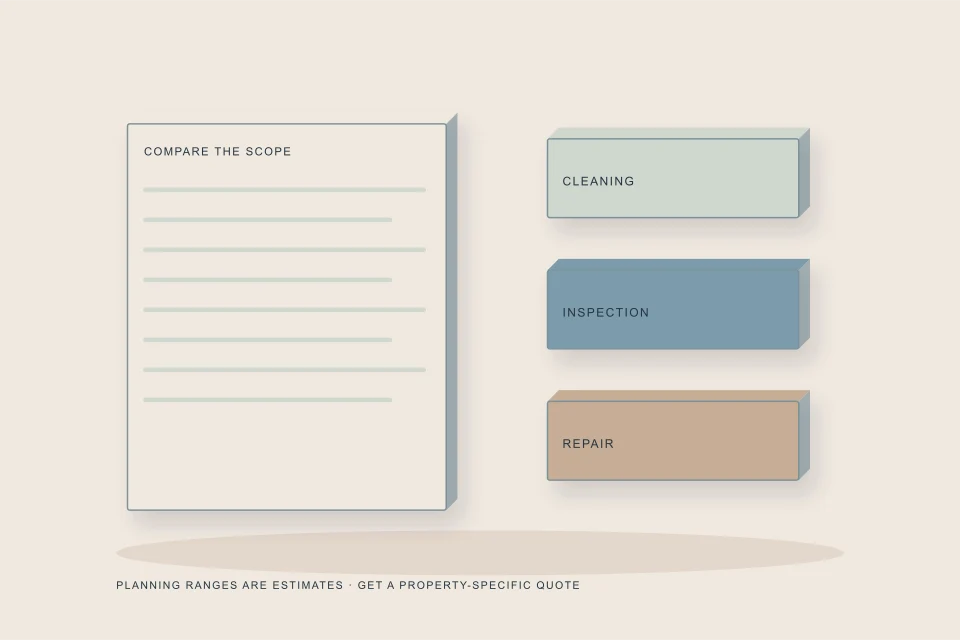
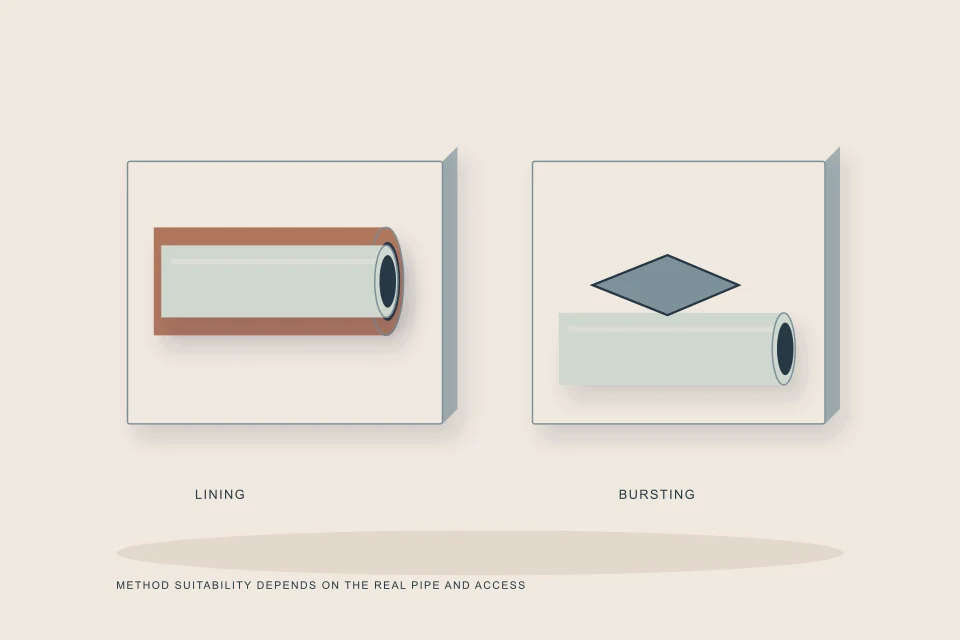
Compare the driveway rows: at 15 m under concrete and deep, open cut plans at $16,450 to $36,850 while lining stays at $9,000 to $23,500. That gap, not the pipe itself, is why trenchless methods are often favoured under hard surfaces. See trenchless repair for whether your line qualifies.
04 /What does the estimator leave out?
- Municipal-side work, such as road or boulevard cuts, where the owner pays for it.
- Permits and inspections, set by each municipality.
- Taxes, GST or HST, and any provincial sales tax.
- Hidden conditions, including rock, high groundwater, a second defect found mid-job, or a line deeper than expected.
- Interior finishing beyond the basement floor allowance, such as flooring, walls and cabinetry.
- Sewage cleanup and root cutting, which are not jobs in the tool; see sewer service costs for their ranges.
- Subsidies, which can reduce a backwater valve's net cost in some cities; see backwater valves.
05 /Why might the estimator differ from a quote you receive?
Because a quote is built on information the estimator does not have. A contractor who has run a camera knows the exact length, depth, material, number of connections and whether the line bends. They also know their own costs, current workload and local permit fees.
| Quote higher than the range | Quote lower than the range |
|---|---|
| Line deeper than the depth you chose | Restoration excluded or minimal |
| Several reinstatements or bends on a lining job | Permit left for you to arrange |
| City-side work or traffic control included | No final camera run |
| Winter thawing or groundwater control | Shallow line and easy access |
| After-hours or short-notice scheduling | Contractor bundling with nearby work |
Neither direction is proof of a problem. Enter the contractor's stated conditions into the estimator and see whether the gap closes; if it does not, ask which item explains it.
06 /How should you use the result?
Use it twice: once before calling anyone, to set a realistic budget, and again when quotes arrive, entering the conditions each contractor described. A quote far below the range usually means something is excluded; far above usually means a condition the tool does not know about. Either is a prompt to ask a specific question, not proof of a problem.
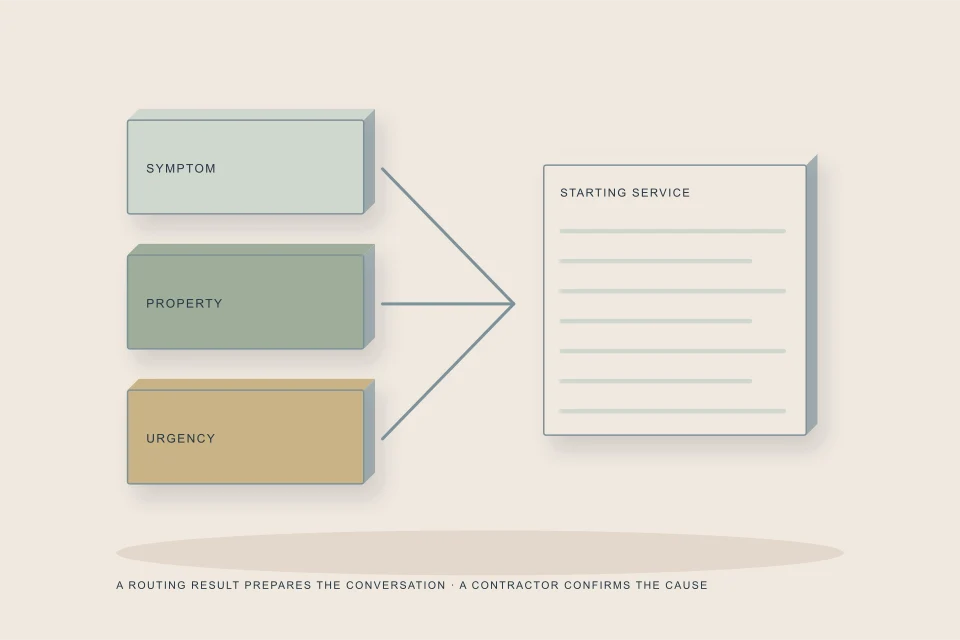
If you do not yet know which job you need, start with the Sewer Service Selector, which routes a symptom to the right lane. For deeper quote comparison, the network's cost specialist is SewerQuotes.com. When you are ready, request quotes and include your footage, the length and depth if known, and what sits above the line.
FAQQuestions people ask
Why does the estimator give a range instead of one price?
Because sewer prices depend on things only a site visit reveals: exact depth, soil, what the camera finds and each contractor's costs. A range is honest about that uncertainty and still useful for budgeting and for checking quotes.
Why does lining not change with depth or surface?
Lining is installed from inside the pipe through a cleanout or small access pits, so it avoids trenching and most surface restoration. Depth and surface mainly change the cost of digging, which lining does not need along the run.
What counts as after hours in the estimator?
Choosing emergency or after hours applies a premium of 1.4 times the low end and 1.6 times the high end to service visits: cleaning, jetting, camera inspection and backwater valve work. It does not apply to excavation or lining, which are normally scheduled.
How much does not having a cleanout add?
The estimator adds $150 to $450 to any job when there is no usable cleanout, covering the extra time of pulling a toilet or working from the roof vent. A contractor may instead quote installing a cleanout, which helps every future visit.
Are sewer cost estimates the same across Canada?
No. The ranges are national planning figures. Labour rates, permit fees, frost depth, soil and restoration standards vary by city and region, so local quotes can sit above or below them.
Why does the estimator treat a backwater valve as a service visit?
Because its price depends mostly on the floor and access around one location rather than on metres of pipe. The only surface option that changes it is a finished basement floor, which adds $500 to $1,500 for extra removal and finishing.
NETWORKGo deeper across the HAUSE Sewer network
Sewer cost estimator
Free sewer cost estimator: choose the job, length, depth, access and surface to get a CAD planning range with the cost drivers behind it, then test real quotes.
SewerRoots.caSewer root removal cost in Canada: cutting, chemicals and permanent fixes
Sewer root removal cost in Canada for 2026: planning ranges for cable cutting, jetting, camera, lining, bursting and replacement, plus cycle-versus-fix math.
PipeCleaning.caPipe cleaning cost in Canada, method by method
Pipe cleaning cost in Canada for 2026: planning ranges for snaking, hydro jetting, descaling, camera inspection and stacks, and what moves a quote.